Southeast Asia Home Appliances 2026: Vietnam Runs Fragmented, Singapore Runs Concentrated
 By Jotham Lim
6 min read
By Jotham Lim
6 min read
Executive Summary#
Get the Full Report: Download the complete analysis for detailed data, methodology, and pages of insights.
Southeast Asia's online home appliance markets are diverging into two distinct archetypes. Vietnam runs small-appliance led and highly fragmented — the ten leading brands collectively hold only 12.0% of share. Singapore runs concentrated and premium — the ten leading brands hold 37.5% of share, with average leading-brand price above CN¥ 2,000. Indonesia (+43.8% YoY) and Singapore (+37.3%) are the growth engines. Same region, different brand-strategy playbooks. Match channel investment to archetype, not to regional headlines.
Regional Frame#
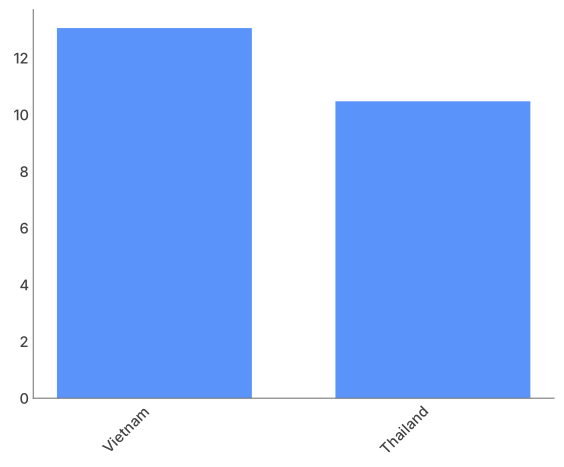
The six-country SEA online appliance basket reached CN¥ 44.98 billion in 2025, up +13.5% year-over-year. Vietnam and Thailand anchor scale (CN¥ 13.05B and CN¥ 10.47B respectively). Indonesia and Singapore are the growth engines, growing +43.8% and +37.3% YoY despite smaller absolute bases.
Vietnam and Thailand anchor scale; Indonesia and Singapore lead growth
Vietnam: The Fragmented Small-Appliance Archetype#
Vietnam is the most fragmented appliance market in SEA. The ten leading brands collectively hold only 12.0% of total sales. PHILIPS leads outright with 2.0% share. The brand structure is highly distributed across origins: Chinese brands hold 31% combined among the leading 100 brands (the largest single bloc), with local Vietnamese brands holding meaningful share alongside.
Vietnam's appliance market is also small-appliance led, not large-appliance led. The five core categories together drive over half of total share:
| Category | 2025 Share | Note |
|---|---|---|
| Fans | 15.0% | climate-driven |
| Blenders | 13.1% | kitchen core |
| Hair removal devices | 9.8% | personal care growth |
| Vacuum cleaners | 8.0% | cleaning core |
| Robot vacuums | 7.3% | smart-home entry |
Air fryers, washing machines, rice cookers, and air purifiers maintain meaningful presence. Gas stoves, coffee makers, and TVs show notable growth — indicating reallocation toward kitchen upgrades and home-comfort solutions.
The Vietnamese appliance strategy implication: brand entry opportunity is real, but the share-building runway is long. There is no dominant incumbent to displace; instead, the long tail of small brands defends share collectively. A new brand entering Vietnam needs either a category-specific specialisation (fan, blender, or hair-removal hero product) or a multi-year multi-channel investment.
Singapore: The Concentrated Premium Archetype#
Singapore is the inverse of Vietnam. The ten leading brands collectively hold 37.5% share — concentrated enough to make the brand-cohort structure the strategic battleground. PRISM+ leads outright with 6.1% share at an average price of CN¥ 4,188. RoborRock grew +111.1% YoY. Happie grew +523.3% YoY. The market is concentrated, premium-positioned, and rewarding category-specific innovation.
The Singapore subcategory mix is distinct from Vietnam's:
| Category | 2025 Share | Note |
|---|---|---|
| Vacuum cleaners | 16.6% | cleaning core, premium-led |
| TVs | 10.8% | mid-to-high-end displays |
| Fans | 8.2% | climate, but smaller share than Vietnam |
| Water purifiers | 7.5% | home-environment emergence |
| Air treatment | 6.0% | home-environment emergence |
Home-environment categories (water purifiers + air treatment) sit among Singapore's highest-volume product groups. This is the signal of a mature high-income market reallocating spend from "buy the appliance" to "improve the home environment". RoborRock's +111.1% YoY growth in robot vacuums and Happie's +523.3% in water purifiers are not anomalies — they are the leading edge of the home-environment reallocation.
Average leading-brand price in Singapore clears CN¥ 2,000. PRISM+'s CN¥ 4,188 average price is the floor for the category leader. Most leading brands have average prices that exceed CN¥ 2,000 — competition revolves around smart features, quality enhancements, and functional upgrades rather than price.
The Two Archetypes in Practice#
The Vietnam and Singapore archetypes are not points on a spectrum. They are structurally different markets that happen to share a region.
In Vietnam, a small-appliance brand wins by:
- Concentrating product development on cooling, kitchen, and personal-care categories
- Accepting a multi-year share-building runway (the leading-10 cap of 12% suggests no single brand can dominate quickly)
- Distributing across multiple e-commerce platforms and traditional channels in parallel
- Pricing in the sub-CN¥ 1,000 band (Vietnam's price-band structure: 69.5% of sales are sub-CN¥ 1,000)
In Singapore, a premium brand wins by:
- Concentrating product development on cleaning, home-environment, and connected-home categories
- Competing on smart features, build quality, and post-purchase service
- Pricing at CN¥ 2,000+ with average-price > CN¥ 4,000 for category leadership
- Allowing for above-CN¥ 3,000 share (40.2% of Singapore's appliance sales)
Brands attempting to use the same playbook across both archetypes typically fail in one or both. The Vietnam playbook (small-appliance + multi-channel + sub-CN¥ 1,000) is incompatible with Singapore's premium-tier competition. The Singapore playbook (premium-cleaning + smart-features + post-purchase service) is incompatible with Vietnam's price-sensitive long tail.
The Mid-Tier: Thailand and Malaysia#
Thailand (CN¥ 10.47 billion) and Malaysia sit closer to Singapore than to Vietnam in structural terms — both have balanced price-band distributions where the CN¥ 1,000-3,000 segment holds approximately one-third of sales (Thailand 31.9%, Malaysia 33.1%). These are the markets where Singapore-tested premium positioning can extend with calibration.
The Philippines and Indonesia sit closer to Vietnam — sub-CN¥ 1,000 dominant (Philippines 83.4%, Indonesia 74.7%), small-appliance-led category mix, fragmented brand structure.
The strategic implication: SEA appliance brands should think in two playbooks, not six. Playbook 1 (Vietnam + Indonesia + Philippines): small-appliance, sub-CN¥ 1,000, multi-channel. Playbook 2 (Singapore + Malaysia + Thailand): premium positioning, smart-feature category leadership, mid-to-high-end pricing.
Indonesia and Singapore as Growth Engines#
Indonesia's +43.8% YoY appliance growth is the fastest in the region. The growth is broad-based across categories rather than concentrated in a single segment, which suggests structural expansion of online appliance penetration rather than a specific category emergence. Singapore's +37.3% growth is concentrated in home-environment (water purifiers, air treatment) and premium-positioned smart-home (RoborRock, Happie).
Both growth signals are consistent with the underlying country profiles. Indonesia is in the volume-expansion phase of online appliance penetration. Singapore is in the premium-reallocation phase, where spend that previously went to large-appliance one-time purchases now goes to recurring home-environment upgrades.
What to Watch Through 2027#
Three signals:
First, Indonesia's appliance brand consolidation. Indonesia's appliance market is currently mid-tier in scale but accelerating fast. Whether a clear brand-cohort structure emerges (mirroring Indonesia 3C's 70.3% Chinese share) or whether the Vietnamese-style fragmentation prevails will determine where the next 18 months of channel investment is best deployed.
Second, the Singapore-to-Malaysia premium signal. Malaysia's balanced price-band structure (33.1% in CN¥ 1,000-3,000) is the closest analog to Singapore in the region. Premium positioning that scales in Singapore typically extends to Malaysia within 12-18 months. The next test cycle will reveal whether 2025's Singapore winners (RoborRock, Happie) extend to Malaysia in 2026.
Third, Vietnam's leading-brand consolidation. The current 12% cap on the leading-10 is unusually low even by SEA standards. Whether one of the existing players (PHILIPS, KAW, SEKA, SUNHOUSE) reaccelerates or whether a new entrant captures share faster than incumbents will reshape the Vietnam playbook through 2027.
About the Data#
Data spans 2025 full-year online consumer e-commerce sales across six SEA countries. Brand cohort shares reference Moojing's proprietary coverage of the highest-volume brand pool per category per country.
More from This Report
This article is part of our Southeast Asia 2026 series:
Download the Full Report
Get the complete analysis with detailed data, methodology, and additional insights.
This content adheres to Moojing's editorial standards .