Southeast Asia 2026: Three Online Consumer Categories Cross CN¥ 165B Together
 By Jessie Wang
7 min read
By Jessie Wang
7 min read
Executive Summary#
Get the Full Report: Download the complete analysis for detailed data, methodology, and pages of insights.
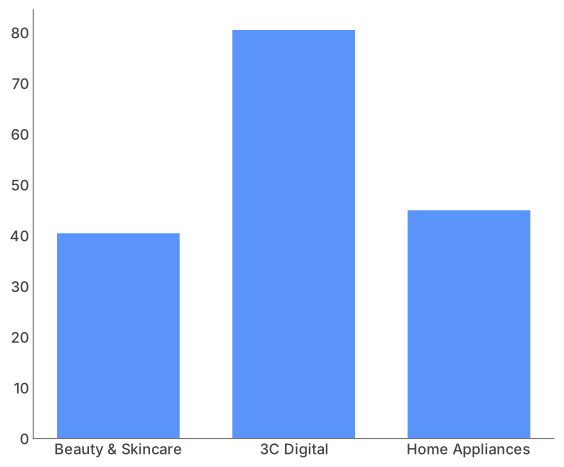
Three Southeast Asia online consumer categories — beauty, 3C digital, and home appliances — collectively crossed CN¥ 165.93 billion in 2025 sales. Each category grew double-digit on top of an already-large 2024 base. Beauty led on growth rate (+23.8% YoY); 3C led on absolute scale (CN¥ 80.50B); appliances threaded the middle (CN¥ 44.98B, +13.5% YoY). Indonesia anchors scale across all three categories. Singapore anchors premium depth across all three. The patterns that hold across all three — Chinese brand supply migration, country-specific premiumisation gradients, and a regulatory clock shorter than the brand-building clock — should reshape how brands plan SEA market entry through 2027.
A Region Past the Bootstrap Phase#
The combined CN¥ 165.93B headline is more than a sum. It is the signal that Southeast Asia's online consumer infrastructure is past the bootstrap phase. Three independent categories grew faster than regional GDP. Three independent country profiles diverged enough to require category-specific playbooks. Three independent regulatory regimes hardened over the same twelve months.
Beauty and skincare reached CN¥ 40.45 billion (+23.8% YoY), the fastest-growing of the three categories on a percentage basis. 3C digital reached CN¥ 80.50 billion (+5.5% YoY) — slower growth, but still the largest single category by an order of magnitude greater than beauty. Home appliances reached CN¥ 44.98 billion (+13.5% YoY) across the six-country basket. Together: CN¥ 165.93 billion.
The composition behind those headline figures is where the strategic value sits.
Three categories, three growth profiles
Pattern One: Chinese Brands Have Completed Supply-Side Migration#
The most consequential pattern across all three categories is the same: Chinese brands have moved from cross-border exporters into category-dominant cohorts in Southeast Asia. The numbers are not opportunistic outliers; they are the structural state of the market in 2025.
In Indonesia's online 3C category, Chinese brands hold 70.3% combined share of the leading brand cohort — a +1.3 percentage-point lift versus 2024. Xiaomi leads outright at 8.6% with the POCO X7 Pro as flagship driver. Transsion's Infinix and Tecno together hold 6.2%. In smartwatches specifically, Huawei holds 19.6% with an average price of CN¥ 816.9, where the Fit 4 series alone delivers roughly 60% of Huawei's smartwatch volume.
In Vietnam's online home appliance category, Chinese brands hold 31% combined share among the leading brand cohort — the largest single bloc among any origin grouping. The Vietnamese market is highly fragmented overall (the ten leading brands across all origins hold only 12.0% of total share), which makes the Chinese cohort's relative concentration even more telling.
In Indonesian beauty, Chinese brands hold 16% of the leading brand cohort and occupy mid-tier skincare positions across all six SEA countries.
The strategic implication is consistent across categories: defensible positioning for a new entrant brand in SEA now requires a product-tier-clear story, not a generic "global brand" framing. The Chinese cohort already covers the full price ladder beneath premium tier — Xiaomi at the entry-to-mid band, Transsion at entry, Huawei competing in premium-adjacent specialty categories. Apple anchors the premium tier in Indonesian 3C as the leading American brand.
Pattern Two: Premiumisation Is Country-Specific, Not Regional#
The second pattern requires care. Premiumisation is real in Southeast Asia — but it is not a regional trend. It is a Singapore trend.
Singapore is the only six-country market where above-CN¥ 3,000 home appliances clear 40% of sales (40.2%) and above-S$1,000 3C digital products clear 60% of sales. The other five markets remain anchored in sub-CN¥ 1,000 mass-market price bands: the Philippines at 83.4% sub-CN¥ 1,000 appliance share, Indonesia at 74.7%, Vietnam at 69.5%.
This matters operationally. Brands testing premium positioning regionally should pilot in Singapore first — it is the cleanest signal we have that a premium proposition can translate into measurable consumer pull. PRISM+ leads Singapore's online appliance market with 6.1% share at an average price of CN¥ 4,188. RoborRock grew +111.1% YoY and Happie grew +523.3% YoY — premium-positioned brands with measurable pull. The Singapore mid-to-high-end signal is robust enough to inform pricing strategy elsewhere in the region; the absolute scale (Singapore is the smallest country basket in our six-country aggregate) is not.
In the volume markets, the playbook flips. Indonesian beauty consumers in 2025 reallocated share toward men's skincare (which grew nearly +200% YoY in Indonesia) and lip liner (which grew +100% YoY) — segments accessible at price points well below premium tier. The mid-band of skincare (CN¥ 40-100) remains the structural anchor.
Pattern Three: The Regulatory Clock Is Shorter Than the Brand-Building Clock#
The third pattern is the one most likely to surprise brand teams that have planned SEA expansion around population and GDP alone. SEA's regulatory environments hardened in 2024-2025, and the timelines are now binding.
Indonesia is the most consequential example. Beauty market entry requires BPOM registration (a 3-4 month process). Mandatory halal certification becomes additive from October 2026 — meaning any brand without halal certification cannot legally sell in Indonesia's beauty category from that date forward. Indonesia 3C entry has already absorbed compliance tightening: average price in the category climbed from CN¥ 33.6 to CN¥ 39.7 in 2025, a quality upgrade rather than a volume tax, driven by product compliance and quality requirements that excluded entry-tier non-compliant SKUs.
The regulatory cycle across the region is similarly active. Thailand's TFDA notification system runs 3-4 months. The Philippines' FDA notification runs 2-4 months. Vietnam's DAV notification system runs 1-3 months. Malaysia's NPRA notification clears in 2-4 weeks. Singapore's HSA reporting clears in 1-2 weeks — making Singapore not only the premium proving ground but also the fastest regulatory pilot route in the region.
For brand teams planning 2026 expansion: build a six-month entry runway into any SEA model. Sequence Singapore first (regulatory speed), Indonesia and Thailand second (volume), Vietnam and the Philippines third (growth), Malaysia opportunistically.
What to Watch Through 2027#
Three signals to follow:
First, the Indonesia mandatory halal threshold in October 2026. The brands that complete certification by Q3 2026 will hold structural advantage through 2027; the brands that do not will see their inventory withdraw from compliant channels. Halal compliance has become a category gate, not a marketing point.
Second, the trajectory of Chinese brand concentration in Vietnam appliances. The current 31% combined cohort share is the largest of any origin bloc but still leaves substantial unconsolidated share — Vietnam remains the most fragmented appliance market in the region. The next 18 months will reveal whether Chinese brands consolidate further or whether local players defend the long tail.
Third, the Singapore-to-Malaysia premium signal transfer. If premium positioning continues to scale in Singapore (RoborRock +111.1%, Happie +523.3% in 2025), the natural next test is Malaysia, which already shows balanced price-band structure (the CN¥ 1,000-3,000 segment holds 33.1% of Malaysian appliance sales — closer to Singapore's pattern than to Indonesia's or Vietnam's).
About the Data#
This article summarises findings from the Moojing Southeast Asia 2026 Whitepaper. Data spans 2025 full-year online consumer e-commerce sales across six countries (Indonesia, Vietnam, Thailand, Philippines, Malaysia, Singapore). Coverage excludes physical retail and B2B/wholesale channels. Brand cohort shares reference Moojing's proprietary coverage of the leading brand pool per category per country — not a full census.
The full whitepaper carries the per-country, per-category data spine plus regulatory entry tables.
Download the Full Report
Get the complete analysis with detailed data, methodology, and additional insights.
This content adheres to Moojing's editorial standards .