Southeast Asia 3C 2026: Chinese Brands Complete the Indonesia Migration
 By Quan Wenjun
6 min read
By Quan Wenjun
6 min read
Executive Summary#
Get the Full Report: Download the complete analysis for detailed data, methodology, and pages of insights.
Chinese brands now hold 70.3% of Indonesia's leading 3C brand cohort, a +1.3 percentage-point lift versus 2024. The supply-side migration into Southeast Asia's largest 3C market is complete. Indonesia 3C reached CN¥ 21.01 billion in 2025 (+28.8% YoY) — the fastest growth rate in the region. Mobile phones and tablets together carry more than half of SEA's CN¥ 80.50 billion 3C category. USB fans grew +144.9% YoY in Indonesia on climate-driven demand alone — a signal that climate-specific product briefs travel beyond regional roll-ups.
Region-Wide: A Mature 3C Market#
The Southeast Asia online 3C digital market reached CN¥ 80.50 billion in 2025 — by far the largest of the three categories we cover (beauty CN¥ 40.45B, appliances CN¥ 44.98B). Year-over-year growth was +5.5%, the slowest of the three on a percentage basis but the highest absolute size by a substantial margin.
The country breakdown reveals where 3C growth is concentrated:
| Country | 2025 Sales (CN¥ B) | YoY Growth |
|---|---|---|
| Indonesia | 21.01 | +28.8% |
| Philippines | 15.10 | – |
| Thailand | 15.50 | – |
| Vietnam | 11.40 | – |
| Malaysia | 8.30 | – |
| Singapore | 3.73 | +18.3% |
Indonesia leads on both absolute size (CN¥ 21 billion) and growth rate (+28.8% YoY). The Philippines and Thailand each cross CN¥ 15 billion as steady mid-tier markets. Singapore grew +18.3% YoY despite the smallest absolute size — consistent with Singapore's role as the premium-share leader in the region.
Mobile phones reached CN¥ 37.41 billion (+22.4% YoY) and tablets CN¥ 7.68 billion (+14.7% YoY) — together carrying more than half the SEA 3C category. The two core categories grew faster than the regional average, which means the rest of the 3C category mix is reallocating downward relative to mobile + tablet.
Indonesia: A Chinese-Led Market#
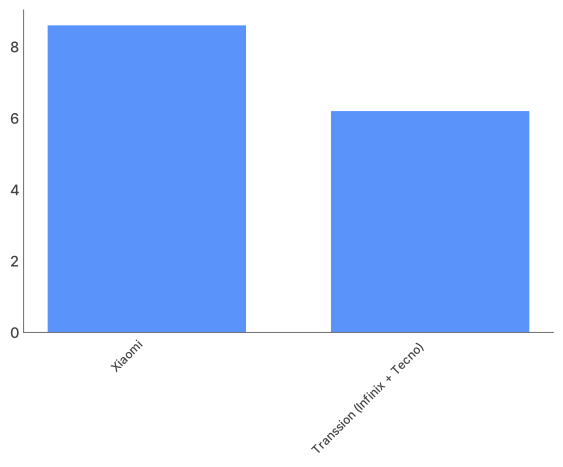
The Indonesia 3C structure is unambiguous: Chinese brands now hold 70.3% combined share of the leading brand cohort, a +1.3 percentage-point lift over 2024. Xiaomi leads outright at 8.6% share, driven by the POCO X7 Pro flagship. Transsion's Infinix and Tecno together hold 6.2%. Samsung and Apple are reallocating toward their respective specialised segments: Apple anchors the premium tier; Chinese brands cover the full price ladder beneath.
Chinese brand cohort dominates Indonesia 3C
Sub-Category Drivers: Climate and Compliance#
The category-level growth pattern in Indonesia 3C tells a more nuanced story than the headline +28.8% suggests. Two themes:
USB fans grew +144.9% YoY in Indonesia. Tropical climate has converted USB fans from a 3C accessory into a primary category. The same pattern appears in the Philippines and Thailand. A global product brief that bucketed USB fans into "accessories" would miss the category entirely. The +144.9% figure outpaces every other 3C sub-category in the region by a 3× margin.
Smartphone accessories continue steady growth. Selfie sticks, chargers, and data cables together represent a non-trivial portion of the long-tail mix. This is the durable mid-tier band where local distributors and white-label products hold meaningful share.
Mobile phones held 46.5% category share in Indonesia with -1.5 percentage point share reallocating toward tablets, smartwatches, and USB fans. The share reallocation does not indicate weakness in mobile — mobile sales grew strongly in absolute terms — but rather that adjacent categories are growing faster off smaller bases.
Case Study: Indonesia Smartwatch and the Huawei Playbook#
Smartwatch in Indonesia is a useful microcosm of the broader 3C dynamics. Huawei leads the Indonesian smartwatch market with 19.6% share at an average price of CN¥ 816.9 — premium-positioned within the category. The Fit 4 series alone delivers roughly 60% of Huawei's smartwatch sales. This is a product-led growth playbook: a single hero SKU carrying most of the category position, with average price high enough to indicate genuine premium consumer pull rather than discount-driven volume.
The market structure beyond Huawei is polarized. White-label products in the CN¥ 0-100 price band account for over 60% of unit volume. The share of products above CN¥ 500 grew +1.6 percentage points, while the CN¥ 100-500 band contracted. The market is reallocating toward two distinct positions: ultra-budget (white-label) and premium (Huawei, brand-specific health-feature ecosystems). The middle is being squeezed.
Singapore and the Premium 3C Position#
Singapore's 3C market deserves its own treatment in any pan-SEA strategy. At CN¥ 3.73 billion absolute size, Singapore is the smallest 3C market — but the only market where above-S$1,000 segment products hold a stable >60% share. Other markets are reallocating upward (under-S$200 share reallocating; above-S$1,000 growing) but Singapore is the only country where the premium share is the structural majority.
The premiumisation gradient is real but Singapore-led: smartphones, tablets, smartwatches in the >CN¥ 1,000 band are growing across the region, lifted by quality requirements and consumer trade-up cycles. Singapore is where this trade-up cycle is most mature.
What to Watch Through 2027#
Three signals worth following:
First, Chinese brand cohort consolidation in Indonesia. The 70.3% combined share is the structural state of 2025. The question for 2026-2027 is whether that cohort consolidates further (likely if compliance tightening continues) or whether Apple and Samsung defend their premium-adjacent niches.
Second, climate-driven category emergence. USB fans are the 2025 case study; air purifiers, dehumidifiers, and personal cooling devices are candidates for the 2026-2027 cycle. Any product brief planning regional launches should factor climate as a primary input alongside population and income.
Third, the Apple premium-share trajectory. Apple anchors Indonesian 3C's premium tier today. If the Chinese cohort develops a premium-tier challenger (Huawei flagship phones returning to international markets is one credible scenario), the premium-tier composition will reshape.
About the Data#
Data spans 2025 full-year online consumer e-commerce sales across six SEA countries. Brand cohort shares reference Moojing's proprietary coverage of the highest-volume brand pool per category per country.
More from This Report
This article is part of our Southeast Asia 2026 series:
Download the Full Report
Get the complete analysis with detailed data, methodology, and additional insights.
This content adheres to Moojing's editorial standards .