The Single-Female Engine Driving China's Pet Conversation
 By Jotham Lim
6 min read
By Jotham Lim
6 min read
Executive Summary#
Get the Full Report: Download the complete analysis for detailed data, methodology, and pages of insights.
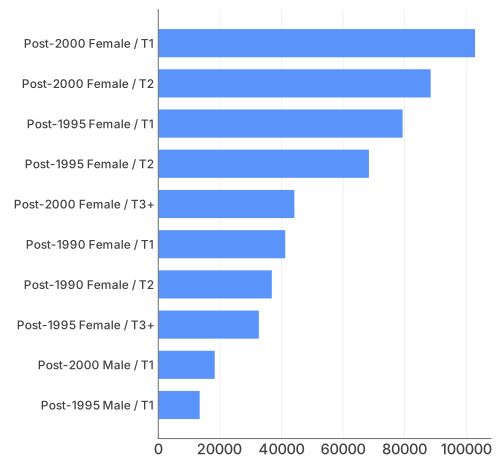
China's pet conversation has a single dominant author: the urban single woman. Multi-platform cohort analysis of Q1 2026 pet posts shows that the top eight content cohorts are all female, with post-2000 women in Tier 1 cities leading at 102,890 quarterly posts — roughly five times the volume of the leading male cohort. Net Sentiment Ratio (NSR) for these female cohorts holds above +0.97 across every age and tier band, the highest sustained reading in our research panel. Mintel's 2025 China pet research provides external validation: 32% of urban pet owners in Tier 1 and Tier 2 cities now identify their pet as a "child," a household-substitution pattern most concentrated among unmarried women aged 20-30. For brands competing in pet food, healthcare, accessories, and services, the implication is decisive — pet category targeting must move from gender-neutral household audiences to a female-led, urban-tier-1-and-2 demand profile, with the creative, channel, and product roadmap recalibrated accordingly.
Who Leads China's Pet Conversation#
The pet category is no longer a gender-neutral household conversation in China. It is a female-led, urban-tier-1-and-2 phenomenon, and the volume gap between female and male cohorts is now wider than at any point in the past four quarters of our research panel.
Multi-platform analysis of Q1 2026 pet posts isolates a clear demographic signal. Post-2000 (born 2000 or later) and post-1995 women in Tier 1 and Tier 2 cities generate the highest pet content volume per capita, the highest engagement quality, and the highest sentiment quality across the cohort matrix. Male cohorts of the same generation and city tier produce meaningfully fewer posts and lower engagement intensity, even when their per-post engagement rates are competitive on a like-for-like basis.
This finding reframes how brand-marketing teams should approach the China pet category. Premium pet food, pet healthcare, accessories, and services demand all flow through this single-female, urban-tier-1-and-2 engine — a cohort whose pet-spending intensity has materially outpaced every peer demographic over the past four quarters.
Cohort Breakdown by Generation and City Tier#
The volume hierarchy is starkest at the top of the chart and remains decisive all the way down to the eighth-ranked female cohort.
Post-2000 females in T1 cities lead all cohorts
Sentiment Quality: NSR +0.97 — The Highest Sustained Reading#
Volume tells one story. Sentiment quality tells a sharper one.
Net Sentiment Ratio (NSR) — Moojing's measure of positive-versus-negative sentiment in social conversation, scaled from -1 to +1 — for the leading female cohorts holds above +0.97 across every tier and age band. This is the highest sustained sentiment reading across any demographic segment in our research panel. By way of comparison, most consumer categories register cohort-level NSR in the +0.55 to +0.80 range; readings above +0.95 are typically reserved for emotionally charged categories such as travel milestones, weddings, and, increasingly, pet companionship.
The brand-mention pattern that accompanies these high NSR readings is equally informative. Among the leading female cohorts, the most frequently mentioned pet brands are Myfoodie (麦富迪), Pure&Natural (伯纳天纯), and a tier of domestic premium pet food specialists. This is a mid-to-premium-tier purchasing pattern, not entry-level commodity buying. The female-led pet conversation is converting into mid-to-premium basket spend.
Mintel External Validation: Pet-as-Child Identification#
The structural driver behind the cohort hierarchy is single-female purchasing power (单身女性消费力), and the pattern is corroborated by independent third-party research.
Mintel's 2025 China pet research finds that 32% of urban pet owners in Tier 1 and Tier 2 cities explicitly identify their pet as a "child" — a household-substitution pattern most pronounced among unmarried women aged 20-30. Post-1995 and post-2000 women in Tier 1 and Tier 2 cities represent a disproportionate share of net-new pet owners over the past three years. Their pet-spending intensity — measured by per-pet annual spend, premium-tier basket frequency, and NSR-adjusted engagement — materially outpaces every peer demographic.
This pet-as-child framing matters operationally because it predicts purchase behaviour. Owners who view their pet as a family member buy differently from owners who view their pet as a domestic animal: they pay premium prices for ingredient transparency, they engage in scheduled health management, they participate in birthday and festival rituals, and they treat aesthetic and emotional content as decision-relevant rather than incidental.
Implications for Brand Marketers#
For brand-marketing teams, the practical implications are immediate and concrete.
KOL roster. Female-led KOL rosters are no longer a stylistic choice but a quantitative requirement. Male-led pet KOL programmes systematically under-index against the actual demand engine.
Creative direction. Content tuned to companionship and emotional bond — the pet-as-family-member framing — outperforms creative that emphasises pet utility, training, or sport. Aesthetic appeal, breed-specific imagery, and family-ritual scenarios align with how the leading cohort already talks about pets.
Channel and distribution. Tier 1 and Tier 2 city distribution should receive disproportionate creative and media weight relative to population share. The Tier 3+ female cohort is meaningful but secondary; it follows trends set in Tier 1 and Tier 2 with a measurable lag.
Product roadmap. Premium positioning, freshness, ingredient transparency, and aesthetic packaging are the attributes that define this cohort's purchasing pattern. Roadmap priorities that ignore these attributes risk under-monetising the dominant demand engine.
Key Takeaways#
- All eight leading pet content cohorts in Q1 2026 are female. Post-2000 women in Tier 1 lead at 102,890 posts; the leading male cohort registers roughly one-fifth of that volume.
- NSR among female cohorts holds above +0.97 across every tier and age band — the highest sustained sentiment reading in our research panel.
- Brand-mention patterns confirm a mid-to-premium-tier purchasing profile (Myfoodie, Pure&Natural, domestic premium pet food specialists).
- Mintel 2025 validates the pet-as-child framing: 32% of urban pet owners in Tier 1 and Tier 2 cities identify their pet as a "child," concentrated among unmarried women aged 20-30.
- Brand-marketing implications are decisive: female-led KOL rosters, companionship-led creative, Tier 1/Tier 2 distribution weighting, and premium product positioning.
About the Data#
This analysis draws on Moojing Market Intelligence (魔镜洞察) multi-platform social-listening research covering the full Q1 2026 quarter. Cohort segmentation combines generation (post-1990, post-1995, post-2000) with city-tier classification (Tier 1, Tier 2, Tier 3 and below). Net Sentiment Ratio (NSR) is calculated as positive minus negative mentions divided by total mentions, scaled from -1 to +1. Brand-mention rankings reflect Q1 2026 volume across mainstream e-commerce platforms and social channels. External validation drawn from Mintel China Pet Owner Research 2025.
More from This Report
This article is part of our report series:
Download the Full Report
Get the complete analysis with detailed data, methodology, and additional insights.
This content adheres to Moojing's editorial standards .