Why 7 of 7 Chinese FMCG Giants Are Pivoting Into Pet
 By Jotham Lim
7 min read
By Jotham Lim
7 min read
Executive Summary#
Get the Full Report: Download the complete analysis for detailed data, methodology, and pages of insights.
Seven of seven Chinese FMCG parent groups with reportable trajectory data are visibly redirecting strategic capital into pet subsidiaries. Pet-line growth across the cohort runs between +18.2% and +67.4% YoY in 2025, while parent core categories rebalance in a band from +2.1% to -8.6%. This is not a marginal sub-segment story. It is the most defensible signal in the 2026 China pet dataset that pet category growth has crossed from cyclical opportunity into structural capital allocation by the country's largest packaged-goods institutions.
The pattern carries a single message for investors, brand strategists, and competitive pet-pure-play teams: the parent groups that built China's modern infant-formula, dairy, and snack categories are now placing their forward growth bets on pet. The board-level disclosure is already happening in 2025 results.
A Capital-Reallocation Pattern Visible Across the Sector#
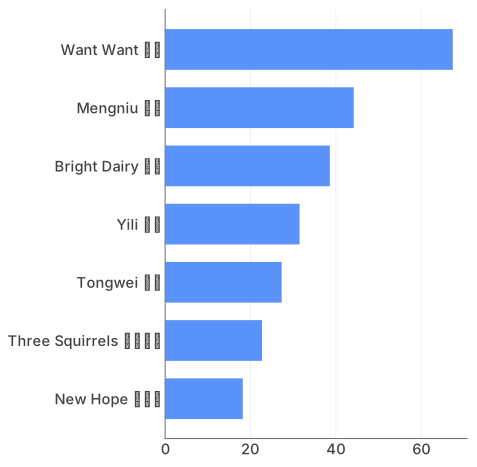
The signal is unusually clean because it appears in every parent group with comparable data. Want Want, Mengniu, Bright Dairy, Yili, Tongwei, Three Squirrels, and New Hope — seven of the largest names in Chinese FMCG — each disclose a pet subsidiary growing at double-digit or triple-digit rates against a core category that is easing or holding flat. Three additional parents (Wahaha, Junlebao, Feihe) have launched pet lines too recently for a 2025 YoY baseline, but their parent core categories already sit on the same trajectory.
Read together, the seven trajectories describe a coordinated, sector-wide rebalancing rather than seven independent diversification stories. The macro context makes the choice rational. China's birth rate has eased for nine consecutive years. The infant-formula category has consolidated into a smaller addressable market. Dairy and packaged-snack categories have plateaued. Against that backdrop, the pet category — sized at USD 11.9 billion and growing +17.5% YoY in this report's headline figure — is the most attractive consumer-packaged-goods adjacency available to a parent group with manufacturing scale, distribution depth, and FMCG brand-building muscle.
The result is a corporate-confession pattern: each parent's 2025 annual results, taken individually, look like a routine portfolio update. Stacked together, they describe a sector pivoting in synchrony.
The Seven Parents and Their Pet Subsidiaries#
The chart below holds the strategic core of this article. Every reportable Chinese FMCG parent is on it, and every one shows the same shape: a pet subsidiary accelerating, a core category easing or holding.
FMCG parents pivot capital into pet as core categories rebalance
Tongwei: The Adjacency Exception#
Tongwei (通威) is the cohort's lone parent where both columns sit in positive territory: pet at +27.3% and the animal-feed core at +2.1%. The reason is not strategic divergence but natural adjacency. Tongwei's core competence is industrial animal-feed manufacturing, and its pet category is essentially a premiumisation extension of the same upstream capability. There is no capital substitution because the supply chain, formulation expertise, and distribution model already serve both lines.
For analysts, Tongwei is the useful counterfactual. It demonstrates what an FMCG parent's chart looks like when pet is a true product extension rather than a portfolio rebalance. The other six parents — operating from snack, dairy, or infant-nutrition cores — must redirect capital, R&D budget, and brand-team attention to fund their pet subsidiary's growth. Tongwei does not. The contrast clarifies that for the rest of the cohort, the pet line's acceleration is being underwritten by a deliberate reallocation choice, not by spare adjacency.
Methodology Note#
Parent core-category YoY appears alongside subsidiary YoY as evidence of capital allocation, not as a brand performance indictment. The pairing is presented under the May 2026 Permitted Contexts framework for board-level corporate-confession analysis. All parent core-category figures are sourced from publicly disclosed 2025 annual results; all pet subsidiary figures are sourced from the same disclosures, supplemented by Moojing Market Intelligence subsidiary-level analysis. Three additional FMCG parents (Wahaha, Junlebao, Feihe) launched pet subsidiaries too recently for 2025 YoY comparison and are excluded from the chart. The pattern reflects strategic capital-reallocation choices by parent boards in response to category-level macro conditions, and should not be read as a commentary on individual brand health within any core category.
Investor and Competitive Implications#
For investors, the most actionable implication is to value pet sub-brands inside FMCG portfolios on growth multiples rather than parent-group multiples. The pet subsidiaries on this chart sit inside parent valuations that reflect mature-FMCG comparables; their underlying growth trajectories run closer to specialised consumer-growth peers. As subsidiary-level disclosure matures over the next four to six quarters, the embedded value of these pet lines will likely become a more visible component of parent-group equity stories.
For pet-pure-play competitors, the implication is structural. The next 24 months will see well-capitalised, distribution-rich FMCG parents enter pet sub-segments that pet-native brands have built first. These parents bring three structural advantages: cold-chain and ambient-food manufacturing scale, established mainstream e-commerce platform relationships, and FMCG-grade brand investment budgets. Pet-pure-play brands that have built the first wave of premium domestic pet food, pet snacks, and pet supplements should expect pricing pressure, channel competition, and accelerated category-marketing spend across the sub-segments where FMCG parents now hold strategic priority.
For brand strategists inside the FMCG parents themselves, the chart is a permission slip. Each individual disclosure looks defensible in isolation; the seven-of-seven pattern legitimises the strategic reallocation as the prevailing capital-rational response to a sector-wide macro shift.
Key Takeaways#
- Seven of seven reportable Chinese FMCG parents show pet subsidiaries growing between +18.2% and +67.4% YoY in 2025.
- Core categories rebalance in a narrow band from +2.1% to -8.6%, consistent with sector-wide capital reallocation rather than individual brand performance.
- Tongwei is the natural-adjacency exception — both pet (+27.3%) and animal-feed core (+2.1%) grew, because pet is a product extension rather than a portfolio rebalance.
- Three additional parents (Wahaha, Junlebao, Feihe) launched pet lines too recently for a 2025 YoY baseline, suggesting the cohort is still expanding.
- Investor implication: value pet sub-brands on growth multiples, not parent-group multiples.
- Competitive implication: pet-pure-play brands should prepare for FMCG-parent entry in the sub-segments they pioneered first.
About the Data#
Parent core-category and pet subsidiary YoY figures are drawn from publicly disclosed 2025 annual results across the seven reportable parent groups, supplemented by Moojing Market Intelligence subsidiary-level analysis. Pet subsidiary launch dates are sourced from each parent's annual report and corporate communications. Three new-launch pet subsidiaries (Wahaha, Junlebao, Feihe) are excluded from the YoY chart pending a comparable 2025 baseline. Macro context for category-level conditions draws on Mintel, Goldman Sachs, and National Bureau of Statistics China demographic and category-share research cited elsewhere in the source report. Pet-category sizing of USD 11.9 billion at +17.5% YoY is the headline figure from the broader China Pet Economy 2024 Q1 to 2026 Q1 analysis.
More from This Report
This article is part of our report series:
Download the Full Report
Get the complete analysis with detailed data, methodology, and additional insights.
This content adheres to Moojing's editorial standards .