Style-First: Why China's College Students Bought the Look, Not the Label in 2025
 By Quan Wenjun
7 min read
By Quan Wenjun
7 min read
Executive Summary#
Get the Full Report: Download the complete analysis for detailed data, methodology, and pages of insights.
In China's 2025 back-to-school season, college students spent CN¥ 5.58B (~US$ 775M) on fashion and apparel — but they bought the look and the moment, not the label. Produced through the Tmall Campus (天猫校园) × Moojing partnership, this deep dive reads a fashion basket defined by limited brand loyalty, where trends and style — not marques — drove the purchase decision. When students chose what to wear, occasion and value-for-money led their thinking, while brand and endorser sat near the bottom. The season moved with the calendar: down jackets anchored the cold January–February window, then campus fashion diversified as March warmed up, helped along by a campus fashion-week campaign that pushed variety and creativity. Underneath the volume, a new style triad — collegiate, affordable fashion, and Y2K — set the mainstream aesthetic, while a small but intensely engaged Chinese Hanfu community showed how niche subcultures punch far above their mention count. For brand teams, the read is clear: on campus, style is the product, and the label is optional.
A CN¥ 5.58B Basket Built on Style, Not Brand#
Fashion and apparel drew CN¥ 5.58B (~US$ 775M) in student spending across the season — a substantial pool, but one with a distinctive shape. Unlike categories where a trusted marque closes the sale, campus fashion showed limited brand loyalty: trends and style did the persuading. Students bought into a silhouette, a colour story, or an aesthetic, and the brand behind it mattered far less than whether the piece fit the moment.
The basket split along familiar lines. Women's clothing accounted for 45% of fashion spend and men's for 24%, with the remainder spread across shared and accessory categories. That women-led weighting matters because, as we will see, women's clothing also generated the season's most intense social engagement — a combination of spend and attention that made it the centre of gravity for campus fashion.
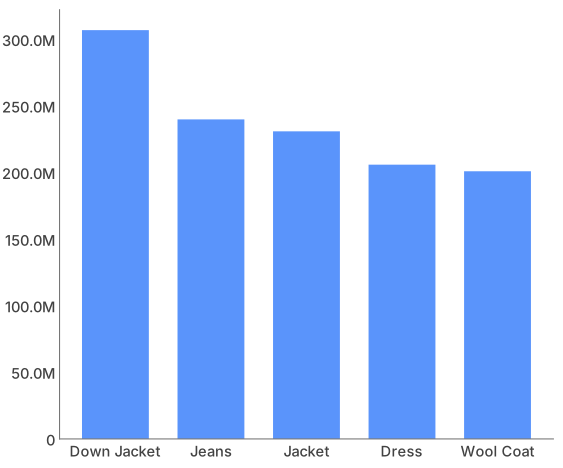
Where the money actually went reads like a cold-season wardrobe warming into spring. Down jackets led fashion spend at CN¥ 0.307B (~US$ 43M), followed by jeans at CN¥ 0.240B, jackets at CN¥ 0.231B, dresses at CN¥ 0.206B, and wool coats at CN¥ 0.201B. Short jackets (CN¥ 0.177B) and women's bags (CN¥ 0.158B) rounded out the most-purchased pieces. The presence of both down jackets and dresses in the same top tier is the whole season in miniature: one wardrobe transitioning from January's cold to March's campus fashion diversification.
Where fashion spend went
Occasion and Value Lead the Decision — Brand Trails#
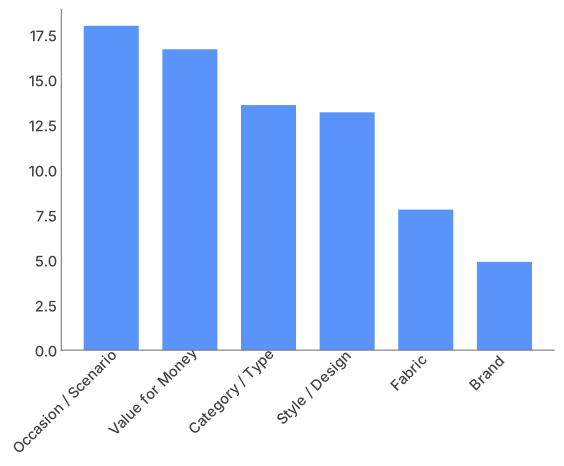
If the spending pattern hints that brand plays a minor role, the way students describe their own choices confirms it. When weighing an apparel purchase, occasion and scenario led their concerns at 18.0%, followed closely by value for money at 16.7%. Category and type (13.6%) and style and design (13.2%) came next, with fabric at 7.8%. Brand registered just 4.9%, and endorser only 2.0%.
Read as a hierarchy, this is a value system, not a shopping list. The two dimensions that lead — where will I wear this, and is it worth the price — are both about fit-to-life rather than status. A student is asking whether a piece works for the lecture hall, the club fair, the weekend out, and the group photo, and whether it earns its place at a student budget. Brand and celebrity endorsement, the levers many apparel campaigns pull hardest, sit at the bottom of the list. This is what style-led rather than brand-led demand looks like when students say it in their own words.
What students weigh when choosing apparel
Engagement Outruns Volume — Where Attention Concentrates#
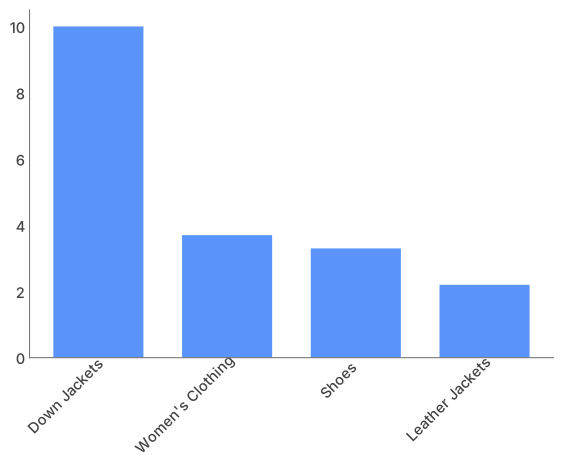
Purchase and passion do not always line up, and the gap is where campus fashion strategy lives. Down jackets, the season's spend leader, carried a 10.0% share of mentions and a 9.2% share of interactions — high on both, as a cold-weather essential should be. But women's clothing tells a more striking story: just 3.7% of mentions, yet 12.2% of interactions, an engagement multiple of roughly 3.3×. Every conversation about women's fashion pulled far more replies, saves, and shares than its raw mention count suggested.
Shoes (3.3% mentions * 6.6% interactions) and leather jackets (2.2% * 7.4%) followed the same pattern — modest in volume, outsized in engagement. For a brand team, this is the discovery signal: the categories where a single post travels furthest are where styling content and community energy compound, not necessarily where the most people are already talking.
Mentions vs interactions — engagement outruns volume
The New Mainstream: Collegiate, Affordable Fashion, and Y2K#
Three aesthetics defined the season's mainstream. Collegiate and preppy styling gave students campus adaptability — a look built for the environment they actually live in. Affordable fashion answered the value-for-money instinct that ranked second in their decision-making. And Y2K carried the subculture energy, importing an early-2000s revival that let students signal an identity, not just a season. Beneath the triad, sub-styles rose in parallel: sweet-cool and soft-masculine both gained ground, evidence that campus fashion is diversifying into ever finer aesthetic dialects — exactly the direction March's campus fashion-week campaign encouraged, as male students leaned into jackets and female students into skirts.
The most instructive story sits at the edge of the data. Chinese Hanfu drew only about 4.0% of mentions — a small slice of the conversation — yet it drew the highest engagement of any style in the season. That inversion is the clearest proof of subculture stickiness in the whole season: a niche community so invested that its members interact at a rate no mass category matched. Low-mention pockets like uniforms tell a similar tale, revealing subculture demand that is easy to overlook and worth tapping. On campus, the size of the audience and the intensity of the audience are two different questions — and the second one is often where the opportunity hides.
Why It Matters#
The strategic read for campus fashion in 2025 is that style is the buying unit and the label is negotiable. Students spent CN¥ 5.58B on a wardrobe they chose by occasion, value, and aesthetic — and largely not by brand. That reorders the marketing playbook: the winning move is not louder brand assertion or a bigger endorser, but showing a piece inside the scenarios students care about, at a price that reads as fair, in the visual language of the mainstream triad or a sticky subculture. The categories where engagement outruns volume — women's clothing, and passionate niches like Hanfu — are where a single well-styled idea travels farthest. Meet students in the look and the moment, and the sale follows.
About the Data#
Produced through the Tmall Campus (天猫校园) × Moojing partnership. E-commerce figures are from the Tmall Campus Marketing Data Center; social-listening figures are from Moojing's proprietary CMI coverage across leading short-video and lifestyle-sharing platforms. Data covers Q1 2025 (January–March). Figures reference the highest-engagement category pools per theme, not a full census, and exclude offline retail and B2B/wholesale channels. Currency conversion uses the 2025 average of roughly CN¥ 7.2 per US$.
More from This Report
Explore the rest of the China Back-to-School 2025 series:
Download the Full Report
Get the complete analysis with detailed data, methodology, and additional insights.
Download the College Student Back-to-School Season Consumption Report
This content adheres to Moojing's editorial standards .