Refined Self-Care 2025: How China's College Students Learned to Read the Label
 By Jessie Wang
7 min read
By Jessie Wang
7 min read
Executive Summary#
Get the Full Report: Download the complete analysis for detailed data, methodology, and pages of insights.
In China's 2025 back-to-school season, college students stopped chasing looks and started reading labels — personal care shifted from basic upkeep to ingredient-savvy "refined repair," and skin maintenance now outweighs makeup. Produced through the Tmall Campus (天猫校园) × Moojing partnership, this study reads how CN¥ 3.72B of student spend across personal care, beauty, and household cleaning reorganised around a single idea: skincare as science. Facial-care sets, lotions, and serums led the spend, amino-acid chemistry dominated the ingredient conversation, and antioxidant-repair awareness rose across the season. Scalp care extended the same logic from face to hairline, and "when will I use this" — the usage scenario — became the most-engaged concern of all. For brand teams, the signal is clear: this cohort buys efficacy it can name, not trends it can only follow.
From Basic Care to Refined Repair#
The defining move of the 2025 campus season was one of maturity. Where an earlier student cohort bought personal care as routine upkeep, this one approaches it as maintenance with intent — a considered, ingredient-aware practice that the season's data frames as "refined repair." Skin maintenance now outweighs makeup in student spend, a reordering that tells you where the attention has gone: less on covering up, more on caring for the skin underneath.
Antioxidation is the clearest marker of that shift. Awareness of antioxidant repair rose through the season, surfacing in how students discuss even the most basic step of their routine. And the maturity extends beyond the face: in household cleaning, students gravitate to leading, trusted brands for dorm-life needs, favouring reliability over experimentation. Across the CN¥ 3.72B category — personal care, beauty, and household cleaning combined — the through-line is a consumer who wants to understand what a product does before it goes in the basket.
Where the Spend Concentrates#
Follow the money and the "refined repair" story holds. The personal-care and beauty basket is anchored not by colour cosmetics but by the maintenance layer — the products that repair, hydrate, and protect.
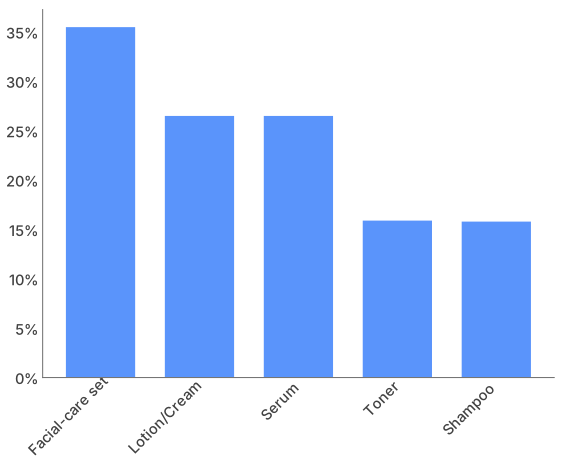
Facial-care sets led personal-care spend at CN¥ 0.355B, the single largest pool and a signal that students buy skincare as a complete regimen rather than one-off items. Lotion and cream (CN¥ 0.265B) and serum (CN¥ 0.265B) followed neck and neck, the two workhorses of daily hydration and targeted repair. Toner (CN¥ 0.159B) and shampoo (CN¥ 0.158B) rounded out the leading five. Set against maintenance, the makeup categories sit noticeably lower — foundation at CN¥ 0.107B, lip at CN¥ 0.097B — confirming at the till what the discourse suggests: skin maintenance carries this cohort's budget.
Facial-care sets and hydration led student personal-care spend
The Ingredient Turn: Naming the Chemistry#
If refined repair is the mindset, ingredients are its vocabulary. Students no longer describe skincare by trend or brand promise — they describe it by the molecule doing the work, a move toward what the season's discussion calls "science-based skincare."
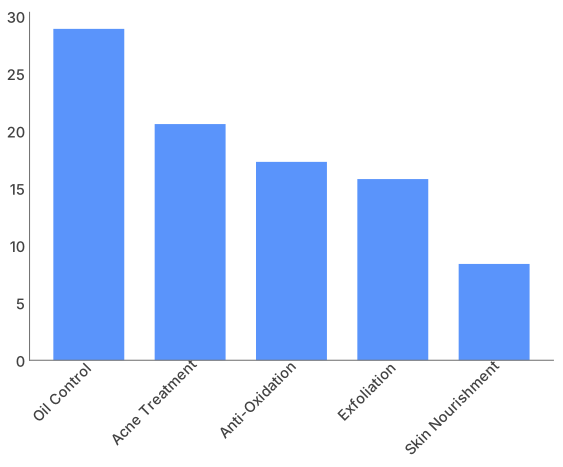
The facial-cleansing conversation makes the priorities legible. Oil control led efficacy discussion at 28.9%, followed by acne treatment at 20.6% — the practical concerns of a young, active cohort. But anti-oxidation already claimed 17.3%, ahead of exfoliation (15.8%) and general skin nourishment (8.4%), showing that repair-minded thinking has reached even the cleanser step. On ingredients themselves, amino acids dominate: 46.3% of interactions and 26.2% of mentions, prized for the gentle, sensitive-skin chemistry that suits daily use. Salicylic acid follows at 16.9% of interactions and 11.4% of mentions, the acne-fighting agent students reach for by name. The pattern is a cohort that has moved from following what looks popular to understanding what actually works.
Oil control led, but antioxidation already ranks high
Scalp-Care Refinement and the Engagement Gap#
The refined-repair logic did not stop at the jaw. It travelled up into hair and scalp care, where oil-control, hydration, and anti-dandruff lead the conversation and fragrance has emerged as a rising value-add — fig, woody, and floral scents turning a functional wash into a sensory one. This "scalp-care refinement" simply extends the hydration mindset from face to scalp, treating the hairline as skin that also deserves maintenance.
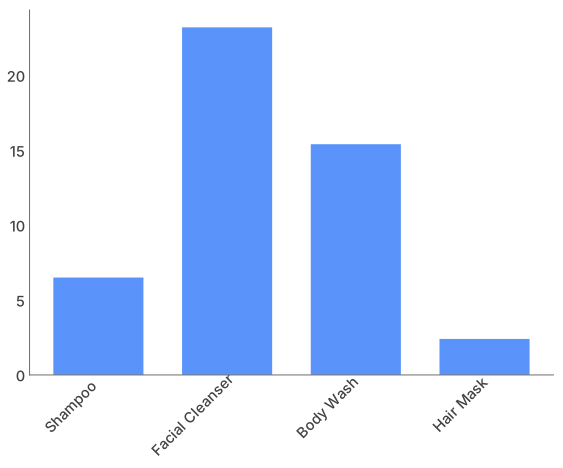
That energy shows up as an engagement gap worth reading closely. Shampoo accounts for just 6.5% of mentions but 44.9% of interactions — roughly a seven-fold engagement multiple, the mark of a category students discuss with real intent rather than in passing. Hair mask shows the same shape (2.4% of mentions, 17.1% of interactions). Body wash inverts it: most-mentioned at 15.4% but lightly engaged at 6.6%, a routine staple that rarely sparks discussion. Facial cleanser leads on both counts (23.2% of mentions, 15.6% of interactions), the balanced anchor of the routine. For brands, mentions measure familiarity, but interactions measure interest — and hair care is where interest is quietly concentrated.
Shampoo draws far more engagement than its mention share
Buying for the Moment, Not Just the Mirror#
The most revealing signal sits one level up from ingredients. When students weigh a personal-care purchase, the concern that draws the most engagement is not efficacy and not brand — it is usage scenario, at 13.2% of mentions and 21.6% of interactions. Students want to know when a product fits their life before they weigh what it contains.
The scenarios themselves map neatly onto campus routine: going out, travel and vacation, and dating lead the discussion. A serum is not just an antioxidant — it is what you apply before a weekend trip; a fragrance-forward shampoo is not just anti-dandruff — it is what you reach for before a date. This is refined repair completing its logic: the cohort has learned to name the chemistry, and now asks that the chemistry earn its place in a specific moment. Products that answer "when will I use this" as convincingly as "what does this do" are the ones this season rewards.
About the Data#
Produced through the Tmall Campus (天猫校园) × Moojing partnership. E-commerce figures come from the Tmall Campus Marketing Data Center; social-listening comes from Moojing's proprietary CMI coverage across leading short-video and lifestyle-sharing platforms. Data covers Q1 2025 (January–March). Discussion and interaction figures reference the highest-engagement category pools per theme, not a full census, and exclude offline retail and B2B/wholesale channels. Currency conversion uses the 2025 average of roughly CN¥ 7.2 per US$.
More from This Report
Explore the rest of the China Back-to-School 2025 series:
Download the Full Report
Get the complete analysis with detailed data, methodology, and additional insights.
Download the College Student Back-to-School Season Consumption Report
This content adheres to Moojing's editorial standards .