China A/W Apparel 2024: The Three Forces That Reshaped a CN¥ 600B Winter Wardrobe
 By Jotham Lim
5 min read
By Jotham Lim
5 min read
Executive Summary#
Get the Full Report: Download the complete analysis for detailed data, methodology, and pages of insights.
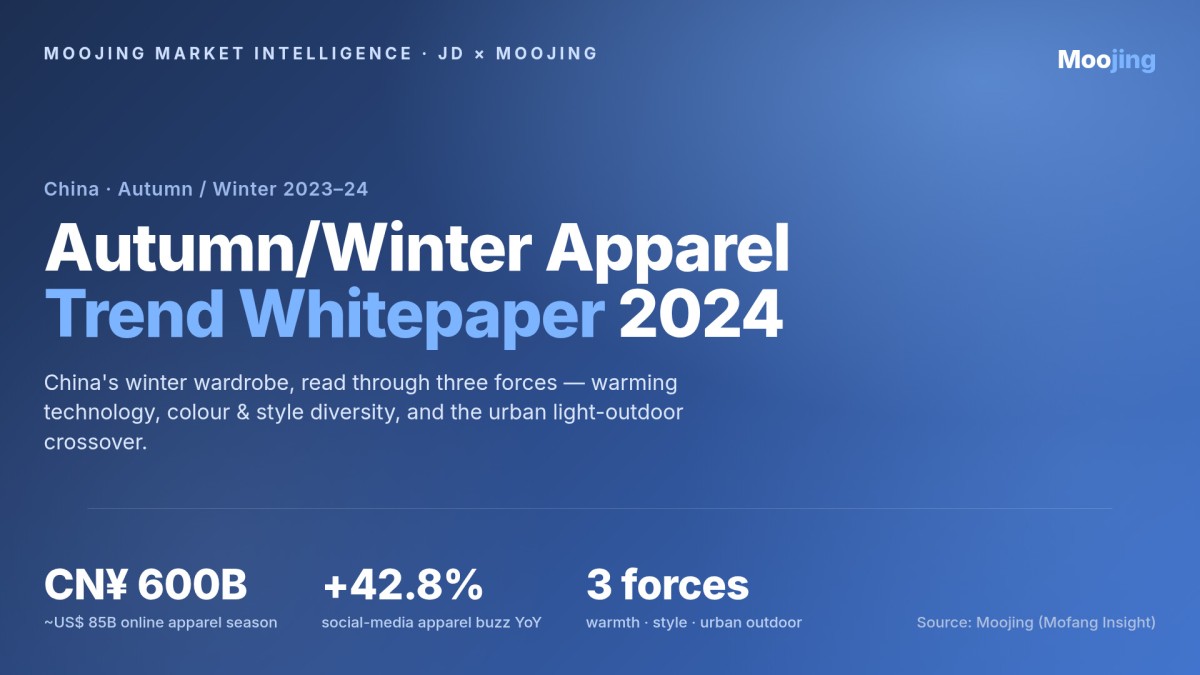
China's Autumn/Winter 2023/24 apparel season on major e-commerce platforms approached CN¥ 600B (~US$ 85B), and three consumer forces decided where that spend went. Produced through the JD × Moojing (Mofang Insight) partnership, this whitepaper reads the season through warming technology that moved from spec sheet to purchase driver, colour and styling that became a form of emotional self-expression, and "light outdoor" apparel that crossed from the trail into everyday urban wear. Social-media apparel buzz rose +42.8% year-on-year, and the fastest-growing categories clustered in outdoor footwear & apparel, kids' clothing & footwear, women's shoes, and accessories. For brand teams, the takeaway is that winter apparel in China now competes on measurable function, emotional expression, and scenario flexibility at once.
A Season That Grew on Outdoor Momentum#
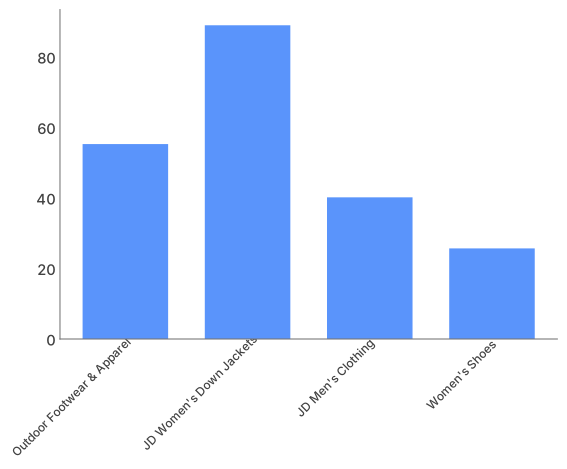
The CN¥ 600B (~US$ 85B) headline is less interesting than its composition. Growth in Autumn/Winter 2023/24 was not evenly spread — it concentrated where function met lifestyle. Outdoor footwear & apparel grew +55.3% in sales and +47.8% in volume year-on-year, the clearest single signal that outdoor momentum drove the season. Women's shoes grew +25.7% in sales and +19.6% in volume.
Inside JD's own fast-growing cohort, the pattern sharpened further: women's down jackets grew +89% in sales and +75% in volume, and men's clothing grew +40.2% in sales and +23.6% in volume. These are not marginal moves. They describe a consumer reallocating winter budget toward categories that solve a functional problem — staying warm, staying mobile — while still expressing personal style.
Attention moved in step with spend. Social-media apparel and styling buzz rose +42.8% year-on-year, with Li-Ning leading engagement after its 2023 endorsement of Teens in Times drove a June 2023 surge to 28M+ monthly engagement. Luxury houses shaped the higher-fashion conversation during the fashion-week calendar. The result is a season where the data and the discourse pointed the same direction.
Outdoor momentum led the season
Force One: Warming Technology Became a Purchase Driver#
The first force is the most measurable. Cold-proof and heat-retention apparel stopped being a marketing footnote and became a reason to buy. Tech-enhanced Autumn/Winter apparel reached CN¥ 2.05B (~US$ 289M) in sales, and the two warming concepts behind it grew +151% (heat-storage) and +119% (cold-protection) year-on-year.
The technology is specific enough to compare. Far-infrared linings — often graphene-based — emit rays absorbed by the skin for an active warming effect: Bosideng's Extreme Cold goose-down jacket pairs a +2.7℃ heating layer with a +2.5℃ insulation layer, and claims 30-second fast heating. Volcanic-rock heat retention, which stores and re-releases body heat, grew +72% in sales, with Gaofan's Black Gold Polar 2.0 claiming +2.0℃ of added warmth. Bosideng, Arc'teryx, and Gaofan anchored the innovation story with claims a shopper can read on a product page and verify in a review.
Force Two: Colour and Style Became Emotional Expression#
The second force is where the season turned personal. Consumers used colour and silhouette as a form of self-expression — an emotional-economy purchase where the palette on the rack is a social calling card. Three colours defined it: Maillard brown carried 5M+ social buzz, grey-toned palettes carried 150K+ buzz, and Ancora Red arrived as a new fashion-week favourite.
Styling narratives ran just as hot. New Chinese style — Mamian skirts, Zen aesthetics, ink-wash motifs — carried 6M+ total buzz, while classic French elegance held 3.2M+ buzz as a "foolproof" reference point. Rising intellectual-minimalist styling (870K+ buzz) and genderless dressing (420K+ buzz) rounded out a season where personal philosophy showed up in the wardrobe. That variety expanded supply across dresses, shirts, and knitwear — the shirt category alone grew +63% in seasonal sales.
Force Three: Light Outdoor Crossed Into Everyday Wear#
The third force connects the other two. "Light outdoor" — park outings, camping, picnics, lakeside days — lifted light-outdoor apparel sales +42% year-on-year, and the look did not stay outdoors. It migrated into commuting, school, and socialising, and cross-platform social buzz for the style rose roughly 4×.
The vocabulary of the crossover is now mainstream: Gorpcore, urban techwear, and Free-Yama styling fuse function with fashion. Shoppers rewarded specific features — thermal, windproof, and breathable led the feature conversation — and softshell jackets, the everyday hero of the category, grew +70% in sales. Demand broadened across women's, men's, and sportswear, confirming that light outdoor is not a niche but a new default layer of the winter wardrobe.
Why the Three Forces Matter Together#
Read separately, each force is a trend. Read together, they describe a single consumer: one who expects a winter garment to be measurably warm, personally expressive, and flexible enough to wear from a commute to a campsite. A down jacket that only insulates competes on price; one that pairs a verifiable warming claim with an on-trend palette and a light-outdoor silhouette competes on value. That is the strategic shift Autumn/Winter 2023/24 made visible, and it is the lens the full whitepaper applies category by category.
About the Data#
This article summarises findings from the JD × Moojing 2024 Autumn/Winter Apparel Trend Whitepaper. Data covers China's Autumn/Winter 2023/24 season (September 2023–February 2024, with 2022/23 comparatives) across online apparel sales and social-media engagement, sourced to Moojing's proprietary Mofang Insight coverage. Figures reference the highest-engagement brand and category pools per theme, not a full census, and exclude offline retail and B2B/wholesale channels. Currency conversion uses the 2024 average of roughly CN¥ 7.1 per US$.
Download the Full Report
Get the complete analysis with detailed data, methodology, and additional insights.
Download the JD × Moojing 2024 Autumn/Winter Apparel Whitepaper
This content adheres to Moojing's editorial standards .