Cold-Proof Tech 2024: How Warming Technology Became a Reason to Buy
 By Jessie Wang
6 min read
By Jessie Wang
6 min read
Executive Summary#
Get the Full Report: Download the complete analysis for detailed data, methodology, and pages of insights.
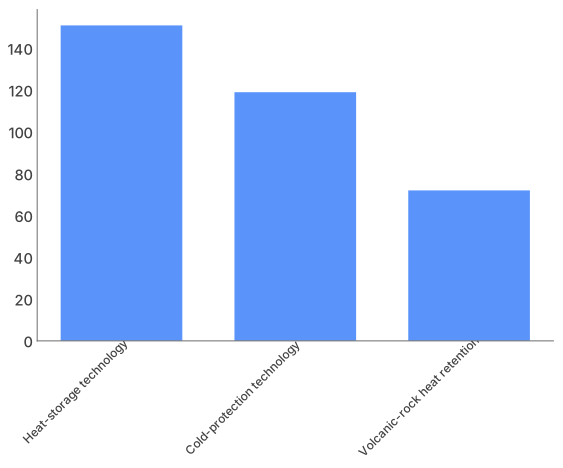
In China's Autumn/Winter 2023/24 season, warming technology stopped being a spec-sheet footnote and became a reason to buy — tech-enhanced apparel reached CN¥ 2.05B (~US$ 289M) in sales. Produced through the JD × Moojing (Mofang Insight) partnership, this deep dive examines how cold-proof and heat-retention apparel turned measurable warmth into a purchase driver. The two warming concepts behind the category grew +151% (heat-storage) and +119% (cold-protection) year-on-year, and brands answered with claims a shopper can read on a product page: degrees of added warmth, seconds to heat, and named material science. Bosideng, Arc'teryx, and Gaofan anchored an innovation story that reframed the winter jacket from a fashion object into a performance product. For brand teams, the lesson is that function is now a merchandising argument, not a disclaimer.
From Marketing Footnote to Purchase Driver#
For years, "warm" was the one thing every winter garment claimed and none had to prove. Autumn/Winter 2023/24 changed that. Interest in cold-proof and heat-retention apparel rose sharply, and the spend followed: tech-enhanced Autumn/Winter apparel reached CN¥ 2.05B (~US$ 289M) in sales. That figure matters less as a headline than as evidence of a shift in what shoppers are willing to pay for.
The two warming concepts underneath the category tell the story of that shift. Heat-storage technology grew +151% year-on-year, and cold-protection technology grew +119%. When a concept more than doubles in a single season, it is no longer an early-adopter curiosity — it is a mainstream expectation. Consumers who once chose a jacket on silhouette and colour were now reading for thermal performance, and the category structure moved to meet them.
The broader season set the stage. Within the cold-proof theme, Down Coat sales grew +50% and Outerwear grew +45% across the season, confirming that the warmest, most technical layers were exactly where winter budget concentrated. Warmth, in other words, was not a tie-breaker between otherwise-equal jackets — it was the primary axis of competition.
The Science on the Product Page#
What made warming technology a purchase driver was specificity. Vague promises of comfort gave way to numbers a shopper could evaluate and a reviewer could test, and two material-science stories led the season.
The first is far-infrared heat retention, often built on graphene-based fabrics. These linings emit far-infrared rays absorbed by the skin for an active warming effect, rather than simply trapping body heat. Bosideng's Extreme Cold goose-down jacket made the case concrete: a +2.7℃ heating layer paired with a +2.5℃ insulation layer, plus a claim of 30-second fast heating. Those are the kind of figures a customer can hold in mind while comparing two products — precise, comparable, and easy to verify against a real-world review.
The second is volcanic-rock heat retention, which stores and re-releases body heat through a mineral lining. This concept grew +72% in sales over the season, and Gaofan's Black Gold Polar 2.0 illustrated the approach: a claimed +2.0℃ of added warmth delivered through a volcanic-rock lining paired with heat-storage chambers. Again, the appeal is legibility — a shopper does not need to understand the physics to grasp "+2.0℃," and that clarity is precisely what converts curiosity into a purchase.
Warming concepts more than doubled
Where the Innovation Story Was Written#
A purchase driver needs a credible author, and three brands anchored the season's innovation narrative. Bosideng brought professional down-leak-proof technology, the kind of engineering that signals a garment built to a technical standard rather than a seasonal trend. Arc'teryx contributed professional outdoor craftsmanship, carrying the authority of the trail into the everyday cold-weather wardrobe. Gaofan (高梵) rounded out the group with premium goose-down, pairing material quality with the volcanic-rock warming story described above.
What unites them is a shared move away from abstract quality claims toward legible, testable performance. Each translated its technology into something a shopper could read on a product page and then check against a review: degrees of warmth, seconds to heat, a named material. That legibility is the mechanism behind the category's growth. When Bosideng states a +2.7℃ heating layer or Gaofan states +2.0℃ of added warmth, the claim invites verification rather than skepticism — and verified claims are what let function command a price.
For merchandising teams on JD and other major e-commerce platforms, the implication is direct. A jacket that only insulates competes on price; a jacket that pairs a verifiable warming claim with a recognised material story competes on value. The gap between those two positions is where the +151% and +119% growth was won.
What This Means for Winter Merchandising#
The through-line of Autumn/Winter 2023/24 is that warmth became a specification, not a slogan. Tech-enhanced apparel reaching CN¥ 2.05B (~US$ 289M), heat-storage growing +151%, cold-protection growing +119%, and volcanic-rock retention adding +72% all point the same direction: shoppers rewarded products that could quantify their performance. The winning claims were specific — a graphene heating layer measured in degrees, a fast-heating window measured in seconds, a mineral lining measured in added warmth.
For brand and category teams, that reframes the winter jacket as a performance product with a data sheet, and it raises the bar for product copy, imagery, and review strategy accordingly. The full whitepaper carries this lens across the season, and the companion articles below extend it into colour, style, and the urban light-outdoor crossover.
About the Data#
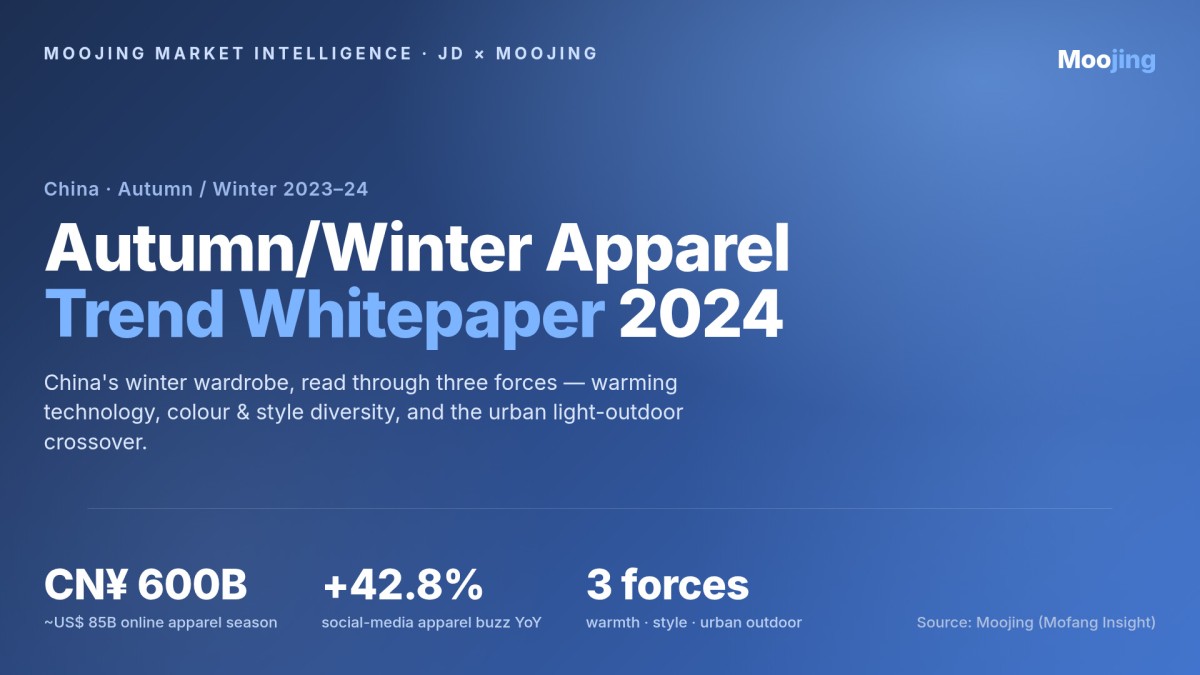
This article summarises findings from the JD × Moojing 2024 Autumn/Winter Apparel Trend Whitepaper. Data covers China's Autumn/Winter 2023/24 season (September 2023–February 2024, with 2022/23 comparatives) across online apparel sales, sourced to Moojing's proprietary Mofang Insight coverage. Figures reference the highest-engagement brand and category pools per theme, not a full census, and exclude offline retail and B2B/wholesale channels. Currency conversion uses the 2024 average of roughly CN¥ 7.1 per US$.
More from This Report
Explore the rest of the JD × Moojing 2024 Autumn/Winter series:
Download the Full Report
Get the complete analysis with detailed data, methodology, and additional insights.
Download the JD × Moojing 2024 Autumn/Winter Apparel Whitepaper
This content adheres to Moojing's editorial standards .