China's CN¥ 383.2B Proactive Health Economy: From Treatment to Precision Prevention
 By Jessie Wang
6 min read
By Jessie Wang
6 min read
Executive Summary#
Get the Full Report: Download the complete analysis for detailed data, methodology, and pages of insights.
China's online health and wellness market reached CN¥ 383.2 billion in 2025, expanding +15% YoY and outpacing overall e-commerce, as the category's centre of gravity moved from treatment to prevention and from general supplementation to precision nutrition. Online dietary supplements alone reached CN¥ 124.5 billion (+19.9% YoY) and online functional food and beverage reached CN¥ 78.8 billion (+11.1% YoY) — together CN¥ 203.3 billion, more than half the market and its fastest large-scale growth. Proactive health is now the mainstream posture: 75.6% of wellness shoppers buy supplements as their primary health behaviour, the buyer base is broadening across gender, age, and city tier, and policy from Healthy China 2030 to a +106-substance medicine-food homology catalog is widening the runway. For brand and investment teams, the prompt is clear — value is reallocating toward mechanism-specific ingredients, scenario-led formats, and credibility-backed claims.
A Market Reallocating From Treatment to Prevention#
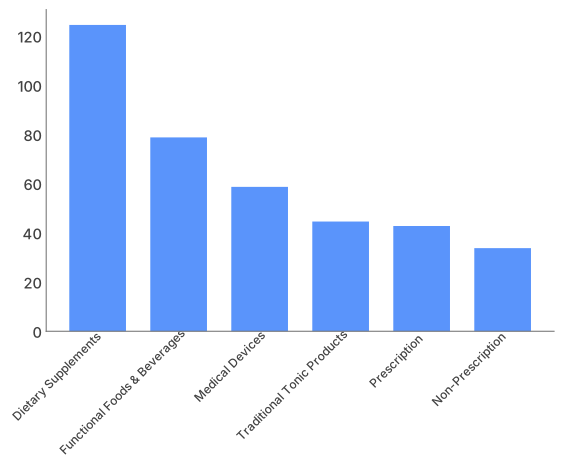
China's online health economy reached CN¥ 383.2 billion in 2025, growing +15% YoY with momentum carrying into Q1 2026. The headline figure matters less than the composition behind it. Dietary supplements and functional food and beverage — the two most prevention-oriented categories — supply the growth, while the market's structure tilts decisively toward proactive nutrition rather than reactive treatment.
Dietary supplements are the largest and fastest-scaling category at CN¥ 124.5 billion (+19.9% YoY), sustaining CN¥ 34.9 billion in Q1 2026 (+15.7%). Functional food and beverage reached CN¥ 78.8 billion (+11.1% YoY). Prescription and non-prescription medicine still grow off their bases — prescription posted CN¥ 42.8 billion (+34.0%) — but the strategic narrative sits with the prevention layer, where a broadening consumer base meets a widening shelf of mechanism-defined products.
Supplements and functional F&B anchor the prevention layer
The Proactive-Health Behaviour Map#
Prevention is no longer an early-adopter habit; it is the default consumer posture. Ranked by share of wellness shoppers, buying health supplements leads at 75.6%, ahead of fitness exercise (61.0%), diet-based wellness (59.8%), self-managed sleep (55.0%), and TCM therapy (42.2%). Wearable health devices (31.8%) and functional F&B purchases (29.4%) round out a multi-channel routine, while medical visits sit far lower at 19.3% — the clearest evidence that consumers are acting before symptoms, not after.
What people buy maps directly onto what they worry about. Top health concerns over the last 12 months span body-image (46%), memory (43.4%), emotional wellbeing (42.2%), immunity (41.9%), neck-shoulder-back comfort (39%), sleep quality (38.7%), vision (38%), and hair (34.4%). Each concern translates into a mechanism-specific segment — and the closer a product maps to a named concern and a real-life scenario, the stronger its growth.
The Buyer Base Is Broadening From Both Ends#
The proactive-health consumer is widening across every demographic axis. Health engagement is becoming more gender-balanced: male participation reached 46.8% in 2025, up from 39.4% in 2024, as men move from passive to active health management. Consumers aged 31-35 remain the core cohort at 19.2% of buyers, with younger groups gaining influence as Gen Z adopts health routines early and favours convenient, snack-like formats.
The base also expands from the senior end. More than 260 million residents aged 60+ lift demand for joint, brain, and heart care, anchoring the category in durable, recurring need. Geographically, demand concentrates in higher-tier cities — Tier-1 (44.0%), New Tier-1 (22.9%), and Tier-2 (14.0%) together represent roughly 81% of buyers, where work and lifestyle intensity drive stronger health consumption. A category growing from both the Gen Z and the 60+ ends, with men entering at pace, has a structurally widening addressable market.
Policy Widens the Runway#
China's prevention shift is reinforced by a coordinated policy backdrop. Healthy China 2030 and the 14th Five-Year Health Plan set prevention-first national goals, while the 2025 Action Plan for Promoting Health Consumption explicitly supports supplement and functional-food innovation. Most consequential for product developers, the medicine-food homology catalog expanded by 106 substances — broadening the legal raw-material base and bringing traditional Chinese wellness ingredients into mainstream formulation. Alongside this, "Blue Hat" registered products grew +21.8% across 2025-Q1 2026 to roughly CN¥ 20 billion, signalling that credibility and regulatory backing convert at a premium.
Three Findings That Hold Across the Report#
First, proactive prevention is now the mainstream consumer posture. Supplement penetration reached 75.6%, demographics broadened on every axis, and demand concentrated in higher-tier cities. With 260M+ residents aged 60+ and an early-adopting Gen Z, the buyer base is expanding from both ends at once.
Second, specialisation is where the growth is reallocating. Supplements moved from general to targeted: sleep, brain health, and anemia are the emerging high-growth segments, while large established segments — immunity, bone, protein, oral beauty — sustain sales through product upgrades. Ingredient value is set by biological mechanism and application scenario, not novelty.
Third, credibility and format innovation unlock the next demand layer. Doctor-endorsed, certified, and "Blue Hat" registered products convert at a premium; novel delivery forms such as freeze-dried rapid-dissolve tablets, oral films, and sprays post triple-digit growth; and medicine-food homology pairings bring traditional Chinese wellness into precise, mainstream formulation.
About the Data#
This analysis draws on Moojing Market Intelligence proprietary research across mainstream e-commerce and social listening platforms, covering 2025 full-year online consumer purchasing with partial Q1 2026 data across China's health and wellness categories. Category sizing aggregates mainstream e-commerce platforms; social-buzz figures reference Moojing's social coverage. Source data was extracted directly from the partner-delivered deck's chart XML (25 charts) and slide text (25 slides), with full methodology caveats disclosed in the source whitepaper. Growth framing follows Moojing's positive-framing house rules: segment language describes the reallocation of growth toward mechanism-specific actives and scenario-led formats rather than absolute category movement.
Download the Full Report
Get the complete analysis with detailed data, methodology, and additional insights.
Download the China Dietary Supplements & Functional F&B 2026 report
This content adheres to Moojing's editorial standards .