China Pet Snacks 2026: Domestic Brands and Festival-Scene Demand Drive a CN¥ 8 Billion Category
 By Quan Wenjun
7 min read
By Quan Wenjun
7 min read
Executive Summary#
Get the Full Report: Download the complete analysis for detailed data, methodology, and pages of insights.
China's pet snack market reached CN¥ 8.19 billion in online consumer sales for MAT 2025, growing +8.1% year over year on value and +5.6% on volume — a maturing category where domestic brands now set the pace and emotional, festival-scene demand opens a premium tier. Cat snacks dominate the segment at CN¥ 6.02 billion (+7.1%), while dog snacks, at CN¥ 2.17 billion (+10.9%), are the faster-growing engine. Beneath the headline, the category is splitting along two clear lines: a value axis, where refined processing technology and superfood ingredients command rising prices, and an emotional axis, where pet "New Year's Eve dinner" formats and human-grade snacks turn a treat into a shared occasion. Domestic brands lead the most-purchased cohort, and several are compounding share at triple-digit rates by pairing founder-led pet IP with transparent, own-factory sourcing.
A CN¥ 8 Billion Category Maturing on Two Axes#
The snack segment is now a substantial, steadily expanding part of China's pet food market. MAT 2025 value reached CN¥ 8.19 billion, up +8.1% YoY, on volume growth of +5.6% — value outpacing volume, which signals buyers trading up to higher-priced, higher-quality formats rather than simply buying more. Within the segment, cat snacks are the scale anchor at CN¥ 6.02 billion (+7.1%), reflecting the large and engaged feline owner base, while dog snacks at CN¥ 2.17 billion (+10.9%) supply the faster growth. The single largest sub-category is cat snack cans, which lead at more than CN¥ 2.3 billion with moderate growth — a mature, stable core. The momentum, however, sits in newer formats: freeze-dried and novelty-shaped categories lead the segment on growth, the clearest evidence that buyers are rewarding both ingredient quality and playful, experiential product design.
Domestic Brands Lead the Cohort#
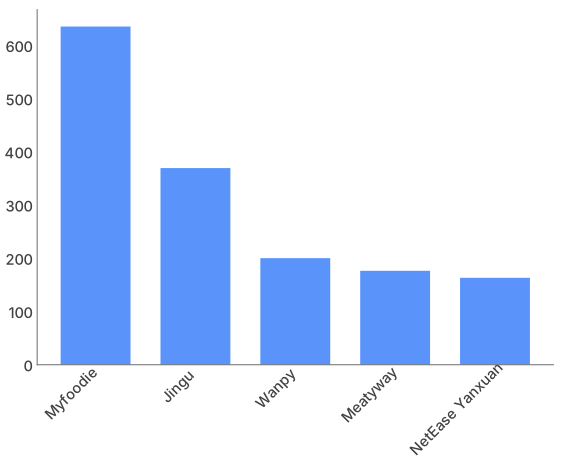
The most striking feature of the brand landscape is how thoroughly domestic names populate the leading cohort. Myfoodie holds the leading position by sales at CN¥ 635.7 million. Behind it, the standout story is Jingu, at CN¥ 369.7 million and growing +174.6% YoY. Wanpy follows at CN¥ 200.4 million, with Meatyway at CN¥ 176.5 million (+14.5%) and NetEase Yanxuan at CN¥ 163.4 million (+19.7%). Further down the cohort, the growth rates are remarkable: Weidangjia +98.7%, Honest Bite +79.1%, Legendsandy +49.7% and Cature +40.6%. The pattern is domestic momentum — established names holding scale while fast-rising challengers compound share at double- and triple-digit rates.
Leading Pet Snack Brands by Online Sales, MAT 2025
The Jingu Playbook: Pet IP Plus Factory Transparency#
Jingu's +174.6% surge is the clearest case study in what is working. Its model pairs founder-led pet IP — a recognisable, personality-driven brand persona that builds an emotional connection with owners — with own-factory transparency, openly disclosing how and where its snacks are made. In a category where buyers are increasingly discerning about ingredients, that combination of warmth and information disclosure builds trust at speed: the IP gives the brand a story owners want to follow, and the open factory gives them proof it is real. The lesson is that scale and credibility are no longer purely a function of legacy — a brand can compound share quickly by being both relatable and verifiable. Other fast-rising names such as Weidangjia and Honest Bite are converting the same trust-led approach into rapid gains.
Selling Points: Dogs Ride the Basics, Cats Refine the Experience#
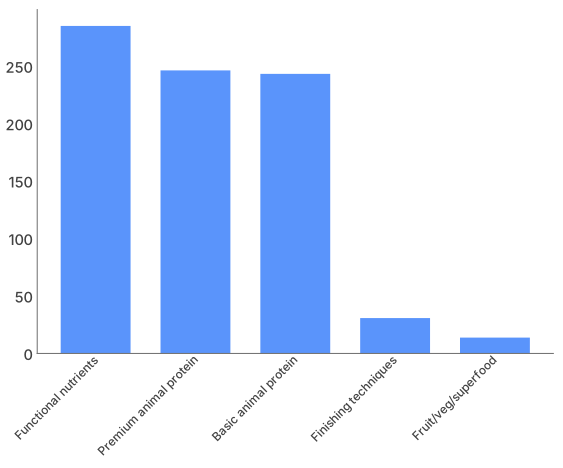
The two species sit on different maturity curves, and the ingredient data makes the split concrete. Across the cohort, refined processing technology is the runaway selling point at +100.2%, followed by fruit, vegetable and superfood formulations (+46.7%) and premium animal protein (+13.2%).
Dogs are riding the basic selling-point dividend: core formula and functional claims grow fastest, and every dimension expands broadly. Cats, already on a well-developed nutritional base, are shifting toward refinement — functional nutrients lead on scale but sit near saturation (+1.1%), while smaller dimensions such as finishing techniques grow +108.4%. The dog owner is still buying the fundamentals; the cat owner is paying for presentation on top of nutrition.
Cat treats refine, dog treats expand across the board
The Emotional Axis: Festival Scenes and Human-Grade Treats#
The most distinctive growth story in snacks is emotional rather than nutritional. Pet "New Year's Eve dinner" orders grew nearly +480% and became a viral social topic — owners buying festive, occasion-specific snack sets so their pets can share in the celebration. This is demand created by scene and sentiment, not by a functional claim, and it points to a premium tier the category is only beginning to exploit. Human-grade formats — zero-additive recipes with high palatability — reinforce the same dynamic, supporting higher unit prices because owners treat the pet snack the way they treat their own premium food.
The scenes differ by species: cats favour interactive snack moments built around play, while dogs favour training-reward scenes that tie the treat to learning. For brand owners, the implication is to design not just a product but an occasion — a snack that fits a festival table, an interactive game or a training session. A festive set or a human-grade recipe earns its price from the moment it enables and the reassurance it offers, which is far harder for a competitor to copy than a formula alone. Occasions that resonate on leading social platforms can build a premium category almost overnight, and the brands that own those scenes early are best placed to keep them.
Where This Leaves Brand Owners#
China's pet snack category is maturing into a two-axis opportunity. On the value axis, refined processing, finishing techniques and superfood ingredients are where price and growth concentrate — most aggressively in dog treats riding the basic dividend, and in the refinement layer cats are migrating toward. On the emotional axis, festival scenes and human-grade formats convert a treat into a shared occasion and unlock premium pricing. Domestic brands have shown the fastest route through both: Jingu's blend of pet IP and factory transparency, and the triple-digit growth across the challenger cohort, show that relatability plus verifiable quality compounds share quickly. The winning playbook is to lead with a credible ingredient story, design for a specific scene, and give Chinese pet owners a reason to feel good about every purchase.
About the Data#
This article summarises findings from the Moojing China Pet Food Market Trends 2026 report. Data covers MAT 2025 (December 2024–November 2025) online consumer sales across China's mainstream e-commerce platforms, with signal from leading social platforms, benchmarked against MAT 2024. Brand cohort shares reference Moojing's proprietary coverage of the highest-volume brand pool per category — not a full census.
Download the Full Report
Get the complete analysis with detailed data, methodology, and additional insights.
This content adheres to Moojing's editorial standards .