October Sales Growth Exceeds 500%, Fuping Persimmon Cakes' Glamorous Turnaround
By Industry Research Team
Key Points of the Article:
-
Moojing Market Intelligence + data shows that in October this year, more than 730,000 Fuping Persimmon Cakes were sold on mainstream e-commerce platforms, with a sales volume reaching 63.12 million Yuan, a 506% increase compared to the same period last year, significantly increasing people’s consumption willingness for this regionally characteristic product.
-
Fuping Persimmon Cakes, a regional brand, has already established wide recognition within the industry. Based on this, continuous upgrades in taste and visual impact will further spawn new brands that align with current consumer habits.
-
Fuping Persimmon Cakes have transformed from a primary agricultural product into a commodity, moving from a festive gift into everyday consumption scenarios. Locally, this has helped build a diversified industrial structure, providing an excellent example for the development of similar agricultural products.
When thinking of autumn and winter limited-time foods, how many people associate them with persimmon cakes? In earlier years, persimmons were a niche fruit, produced only in certain regions, and the persimmon cakes on the market were mostly unattractive. However, with the development of online channels over the past two years, and various new tea beverage brands promoting the concept of persimmons, this fruit has gradually come into public view. Among them, the most representative is Fuping Persimmon Cakes from “China’s Persimmon Town,” Fuping County.
Moojing Market Intelligence + data shows that in October this year, consumers purchased over 730,000 Fuping Persimmon Cakes on mainstream e-commerce platforms, achieving a sales volume of 63.12 million Yuan, a 506% increase compared to the same period last year, showing a significant increase in consumers’ desire to purchase this regionally characteristic product.
What interesting stories lie behind a simple persimmon cake? From the data perspective, what distinct consumer trends can we discern? What lessons from the success of Fuping Persimmon Cakes can be applied to other regional agricultural products? Let’s take a look together.
A Small Persimmon’s Glamorous Turnaround
Fuping County is located in the central part of Shaanxi Province, at the transitional zone between the Shaanbei Plateau and the Guanzhong Plain, with fertile land, abundant sunshine, and significant diurnal temperature variation, making it a well-known high-quality persimmon production area. Here, the nationally geographically indicated “Fuping Tip Persimmon” is produced, which is heart-shaped or spindle-shaped, high in sugar content, and nutritionally rich, with a cultivation history of more than two thousand years.
Although persimmon cakes can be considered only primary processed agricultural products, their production process is quite elaborate, involving twelve steps such as peeling, hanging, heart-poking, and frost attracting. The local traditional craft is the hanging method, which involves hanging strings of persimmons on high poles after the first frost of autumn, waiting for time to work its magic.
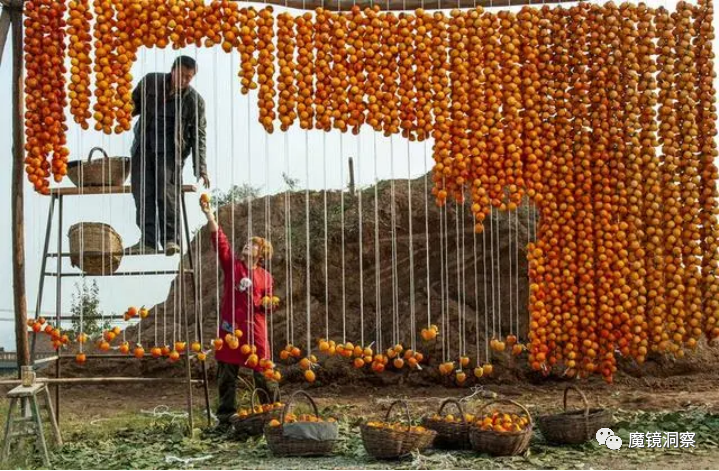
The soft and moist core is a significant feature of Fuping Persimmon Cakes. To form this tantalizing center, experienced masters must perform “heart-poking” manually during the drying process, often needing to poke 2-3 times throughout the cycle; the goal is to accelerate the loss of moisture from inside the persimmons through specialized kneading techniques. After over a month of sun-drying and wind-drying, sweet and soft persimmon cakes are ready for market distribution.
Fuping County has the highest persimmon production in the country, and the locality has shed its impoverished county status relying on this pillar industry. According to reports, in 2022, Fuping County’s persimmon production reached 280,000 tons, with persimmon cake processing amounting to 70,000 tons, creating a total output value of approximately 6.5 billion Yuan.
However, behind the impressive data, there are some twists in the story, resembling a rerun of the Yunnan coffee bean story. For a long time, the profits from Fuping Persimmon Cakes were firmly controlled by foreign capital. Persimmon cakes did not have a broad domestic audience as they do now, but were hugely popular in Japan and Korea. Korean businessmen recognized the hidden opportunity, established stable supply channels at higher prices with in-depth market research, and then started to significantly lower the purchase prices when supply exceeded demand. Since the Koreans purchased the fresh fruit rather than the finished persimmon cakes, and knowing that fresh fruit does not store well, Fuping farmers had to accept the low prices to minimize risk. After several years of being exploited, the locals eventually proactively connected with external markets, and the government began to strongly support local brands, thereby laying the foundation for Fuping Persimmon Cakes to be “seen” by global consumers.
According to reports, last year about 500 tons of Fuping Persimmon Cakes were exported overseas. Today, persimmon cakes are no longer merely simple primary agricultural products, but a regional commodity that can generate revenue and represent the local customs of Fuping.
Online Channels Boost Regional Products to Break Market Boundaries
Before the rise of online channels, the main sales outlets for agricultural products were agricultural markets and downstream distributors, with either channel tending toward a buyer’s market and struggling to form a brand effect, with very limited profit margins. However, with the rise of internet platforms, e-commerce platforms have enabled sales beyond geographical limitations on the one hand, while social media increased the exposure of niche products, offering possibilities for branding on the other. Fuping Persimmon Cakes have indeed seized the online opportunities.
According to Moojing Market Intelligence, from December 2022 to November 2023, the sales revenue of Fuping Persimmon Cakes on mainstream e-commerce platforms reached 210 million Yuan, up 88.2% year-on-year; the products are mainly concentrated below 138 Yuan, as a primarily processed agricultural product with a relatively single form, SKUs are usually divided by specifications and packaging methods, with the price per jin mostly between 30-50 Yuan.
E-commerce data shows that Fuping County accounts for half of the national persimmon cake industry. During the same statistical period, the total sales of persimmon cakes reached 400 million Yuan, up 40.8% year-on-year. It is evident that Fuping Persimmon Cakes are leading the segment and the concept of “Fuping” as a core production area for persimmon cakes is gaining increasing recognition among consumers.
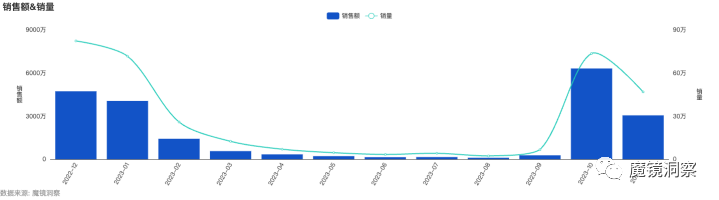
Similar to other primary processed agricultural products, the production of persimmon cakes must adhere to seasonal patterns, with the products mostly listed from October to December. Therefore, sales performance also shows significant seasonality, with consumption mainly concentrated from October to the following February. Notably, in the past year, the overall sales revenue of Fuping Persimmon Cakes on Douyin channel increased by 216.4%, with the “short video + live streaming” sales model bringing new growth opportunities for agricultural products.
In China’s agricultural product market, there is a common phenomenon of having a category but no brand, with many “geographical signifier” concepts, such as Aksu Heart-shaped Apples, Sichuan Baba Mandarin, and Gannan Navel Oranges, but few are brands like Zespri that immediately come to mind when mentioning kiwifruit. The same is true for Fuping Persimmon Cakes. At present, online sales of Fuping Persimmon Cakes are relatively scattered, with the main sellers being Fushi Dried Persimmon and Fushi Persimmon Cakes, and numerous merchants directly naming their products “Fuping Persimmon Cakes,” indicating that brand development is still in an early stage.
Giving gifts during festivals is one of the main consumption scenarios for persimmon cakes, with high-quality Fuping Persimmon Cakes being soft, sweet, and suitable for all ages. According to Moojing Market Intelligence, many users choose to buy Fuping Persimmon Cakes as gifts for family or friends. In terms of consumption motivation, taste is the primary factor for people buying Fuping Persimmon Cakes, so what conditions should a delicious piece of persimmon cake meet?
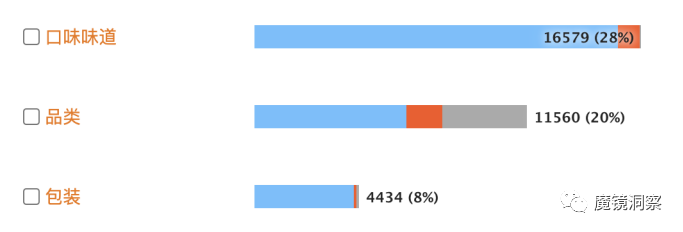
First comes the sweetness—persimmon cakes should have frosting, a white frost that naturally forms during the aeration process is almost a consensus among consumers, with the saying “may all your endeavors succeed, good persimmons turn into frost.” Next is a delicate mouthfeel, ideally with a flowing heart, which is a feature of Fuping Persimmon Cakes; moreover, the freshness of the persimmon cakes is also crucial. Negative reviews mostly revolve around complaints regarding taste, with some users grumbling about persimmons being too astringent, too sour, or not fresh enough.
As an agricultural product, persimmon cakes naturally exhibit non-standardized characteristics. Thus, issues can easily arise in product quality control, storage, and other links, which need to be addressed by enterprises in the future. Establishing a set of grading standards for persimmon cakes (such as size, thickness of the sugar frost, and inclusion of a soft heart) and providing consumers with quality, consistent, and controllable products will be key to success in the industry.
Refined and Industrialized: Fuping’s “New Persimmon Story”
As Fuping’s place-of-origin advantage captures consumer attention, Fuping Persimmon Cakes have gradually become widely recognized in the market, with the industry moving towards greater refinement.
Persimmon cakes used to be mainly bought as holiday gifts, but now as the audience continues to grow, persimmon cakes have also become a choice for everyday snacks. According to Moojing Social Media Intelligence, in the past rolling year, social media platforms have shown a 114% increase in discussions about persimmon cakes in workplace scenarios, with significant increases also in scenarios such as watching dramas, staying at home, and drinking tea. To meet people’s daily consumption needs for persimmon cakes, two trends are emerging on the market: on one hand, derivative flavors are becoming increasingly diversified, and on the other, packaging is getting more exquisite.
In recent years, persimmon cakes, as a snack, have been continuously innovating. Date-stuffed walnuts have been a popular health snack in recent years, leading to the emergence of persimmon cakes stuffed with walnuts on the market. A food blogger once recommended a way to eat persimmon cakes on social media platforms, by cutting seasonal persimmon cakes open, laying a small piece of butter on top, and warming them in the oven until the butter slightly melts. This allows one to taste a slice of persimmon cake with both the savory richness of dairy and the sweet juiciness of fruit. Consequently, merchants have followed this idea, introducing butter persimmon cakes, cheese persimmon cakes, and more…
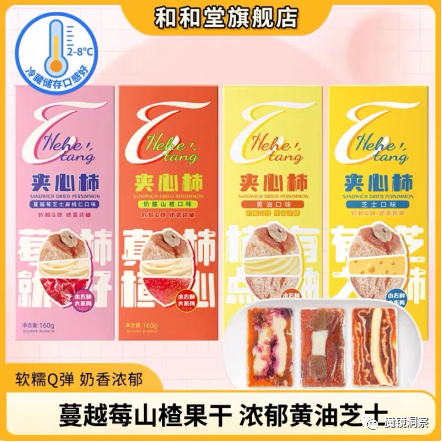
According to [Moojing Market Intelligence]+, over the past rolling year, related products’ total sales have reached 12.8 million yuan, up 94.2% year-on-year, with products made from Fuping persimmons accounting for about 2.52 million yuan. Even though complex-flavored persimmon cakes are currently a relatively niche category, as more and more people start consuming persimmon cakes as a daily snack, the product forms are likely to develop into a diverse range, with great potential for growth in complex-flavored persimmon cakes in the future.
In terms of packaging, the packaging of Fuping persimmon cakes, previously a rudimentary agricultural product, was relatively simple, with some even lacking individual packaging. Today, individual packaging has become widely prevalent, and complex-flavored persimmon cakes have adopted single-slice packaging forms, with the overall packaging design style also being more in line with the aesthetic preferences of young consumers.
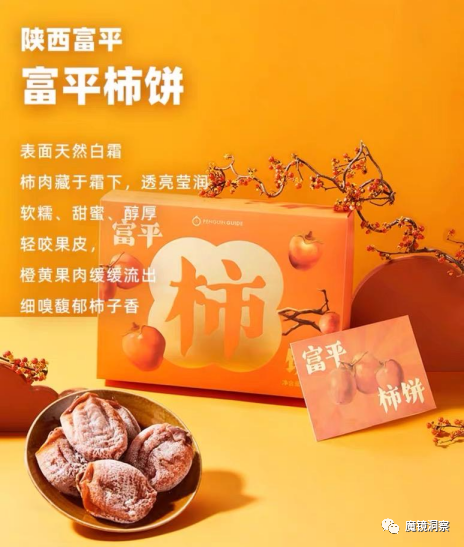
The Fuping persimmon cakes, as a geographically specific brand, have already established broad recognition within the industry, and on this basis, continuous upgrades in taste, visual effects, among others, will further foster new brands that align with current consumer habits.
Fuping County’s leading persimmon production in the nation also creates unique conditions for developing related deep-processing industries locally. Since persimmons are sugary fruits, they are excellent raw materials for making jams and fruit wines. Beyond processed foods, persimmons can also be used in the clothing and textile sector. Persimmon dyeing is a traditional Chinese folk craft, where juice pressed from green persimmons is turned into a varnish, which is then used to soak and dye fabrics like cotton, linen, silk, and wool. Green persimmons, which would ordinarily be discarded as waste in food processing, are utilized through persimmon dyeing. In May this year, China’s first modern persimmon varnish production line was established in Fuping, with the collaboration between the Jiangsu Branch of the Chinese Academy of Sciences’ Institute of Botany and the People’s Government of Fuping County, forming the “China Fuping Persimmon Dyeing Research Center,” whose output is expected to reach 80 tons next year.
With the seemingly ordinary persimmon, Fuping has achieved a diversified development of its industrial structure.
Summary
From being an agricultural product to gradually becoming a branded commodity, persimmon cakes have entered more consumers’ everyday lives, becoming a great companion for overtime work or while binge-watching dramas; extending from persimmon cakes to other deep processing fields, Fuping County has also realized the upgrading and transformation of its industry.
More importantly, the success of Fuping persimmon cakes has shown the market the potential of regional agricultural products. Whether it is vertical branding or horizontal linkage with related industries, Fuping persimmon cakes provide an excellent example for the development of similar agricultural products.