Q1 2024 Whitepaper: China's Beauty & Skincare Market Analysis
Overview
Comprehensive analysis of China's beauty & skincare market, Q1 2024: category sizing, fast-growing segments, brand and demand signals from Moojing data.
All reports follow our editorial standards and research methodology .
Key Findings
Key Finding 1
China's online beauty & skincare market reached CN¥ 98.33 billion in Q1 2024, up +1.3% YoY — a modest recovery driven by mid-to-low-price products as the market digests a structural shift toward value.
The market's volume growth far outpaced revenue — units sold rose +16.2% YoY to 990 million, confirming that average selling prices declined as consumers increasingly favored sub-CN¥ 100 products. In the beauty segment, the under-CN¥ 100 price tier led with +25.3% revenue growth. In skincare, the CN¥ 300–500 range was the standout, growing +10.6%, while the CN¥ 500+ tier broadly contracted. Channel dynamics reinforced the Douyin (抖音) dominance story: platform revenue grew +42.9% YoY, expanding Douyin's market share by 13.8 percentage points. This signals a decisive shift in where beauty consumers discover and purchase products, with implications for brand investment strategies.
Key Finding 2
TOP10 brands grew +23.6% YoY — 18x the overall market growth rate — confirming that the beauty & skincare market is polarizing between leaders and the long tail.
Domestic brands are the primary beneficiaries of this concentration. Kans (韩束) delivered the most dramatic result, with brand revenue growing +499.6% YoY to CN¥ 2.33 billion, driven by a purpose-built Douyin custom drama strategy co-produced with influencer Jiang Shiqi. Proya (珀莱雅) grew +71.3% to CN¥ 2.27 billion. Among international brands, La Mer and Whoo (后) showed strong growth (+18.0% and +50.0% respectively), while SK-II declined -26.8% and Lancôme (兰蔻) slipped -5.1%. The CR10 expanded by 3.0 percentage points, while the tail — brands ranked outside the top groups — lost -8.7% and shed 5.6 pct of market share, despite registered brand counts growing +11.7%.
Key Finding 3
Two parallel consumer themes defined Q1 2024: "precision skincare" as a functional framework, and beauty-as-emotional-outlet as a behavioral driver — together reshaping product demand and social media content.
On the functional side, "barrier repair" social media discussion grew +657.9% YoY, and "precision skincare" topics grew +686.4% — both well above the market's +96.2% overall voice share growth. On the sales side, collagen supplementation products grew +58.4% to CN¥ 5.29 billion GMV, and single-use essence ampoules grew +56.7% to CN¥ 1.83 billion. On the emotional side, "dark/gothic makeup" products grew +45.0% in revenue and +217.4% in voice share, as young female consumers embraced expressive, non-conformist aesthetics. "Emotional skincare" as a concept saw +40.3% sales growth.
Key Finding 4
Makeup remover and blush — both historically small categories — are on divergent upgrade trajectories that signal deeper structural shifts in how Chinese consumers approach beauty routines.
Makeup removers grew +9.7% YoY to CN¥ 1.64 billion, but the category composition is shifting dramatically: cleansing oils (+24.1%) and cleansing balms (+23.0%) gained share while cleansing water fell -14.7%, as consumers moved away from cotton-pad-based routines toward more thorough, skin-friendly formats. Social media discussion of makeup removal grew +131.7% YoY. Blush grew +43.3%, with cream blush now accounting for 46.3% of the sub-category — up 15.3 pct in one year. Notably, male consumers accounted for 29.1% of makeup remover discussion and 32.0% of blush discussion, signaling sustained male grooming market expansion.
| Region |
China
|
| Industry |
Beauty & Skincare
|
| Report Type | Market Analysis |
| Language | en |
| Author | MooJing Research Team |
Frequently Asked Questions
China's online beauty & skincare market reached CN¥ 98.33 billion in Q1 2024, up +1.3% YoY — a modest recovery driven by mid-to-low-price products as the market digests a structural shift toward value. The market's volume growth far outpaced revenue — units sold rose +16.2% YoY to 990 million, confirming that average selling prices declined as consumers increasingly favored sub-CN¥ 100 products. In
TOP10 brands grew +23.6% YoY — 18x the overall market growth rate — confirming that the beauty & skincare market is polarizing between leaders and the long tail.
Two parallel consumer themes defined Q1 2024: "precision skincare" as a functional framework, and beauty-as-emotional-outlet as a behavioral driver — together reshaping product demand and social media content.
This report provides comprehensive analysis of China's online beauty skincare market in Q1 2024, covering market sizing, category segmentation, brand competition, consumer trends, and growth opportunities based on e-commerce sales data from major platforms including Tmall, JD.com, and Douyin.
This analysis is based on MooJing Market Intelligence data tracking e-commerce sales across 30+ major platforms in China and internationally, including Tmall, JD.com, Douyin, Pinduoduo, Amazon, and Shopee, with SKU-level granularity and verified transaction data.
Related Reports

China's World Cup 2026: How Chinese Shoppers Spent Before the June Kickoff
How Chinese shoppers spent more and more on football gear, drinks and snacks in the months before the 11 June World Cup kickoff — even though the national me...
College Student Back-to-School Season: China's 2025 Q1 Campus Consumption — Subsidised Devices, Refined Self-Care, and Style-First Fashion
China back-to-school consumption 2025: turning campus e-commerce and social data into competitive advantage across categories, brands and student demand.
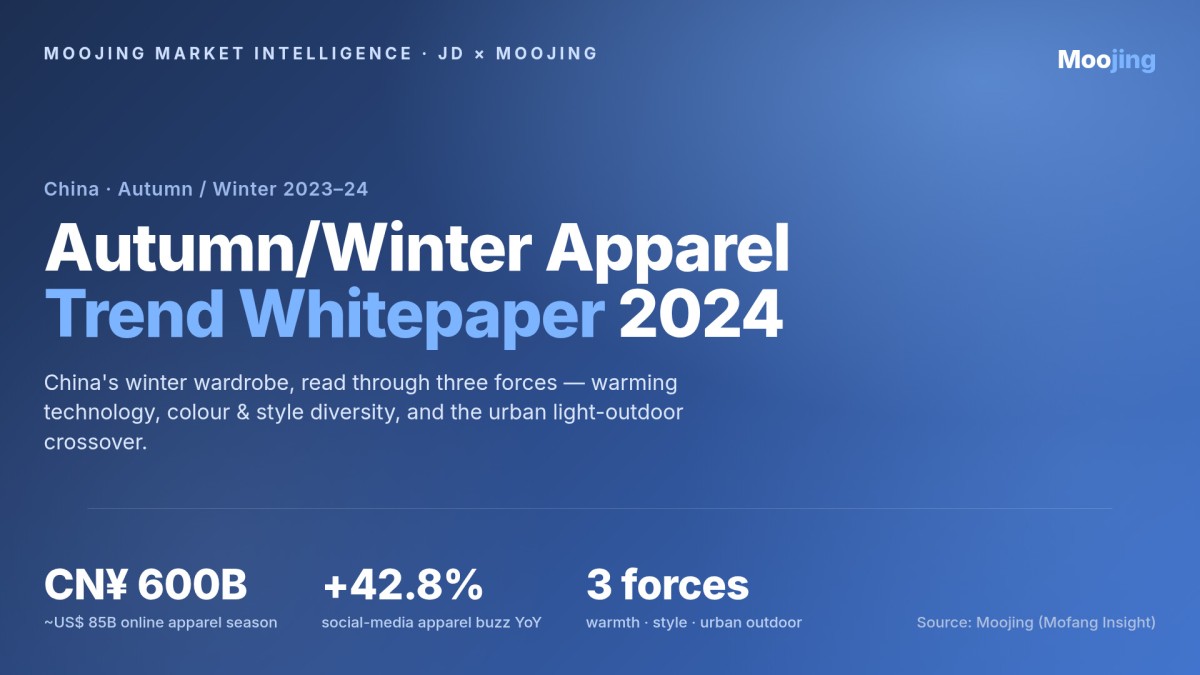
JD × Moojing 2024: Autumn/Winter Apparel Trend Whitepaper — Warming Technology, Style Diversity, and the Urban-Outdoor Crossover
JD.com autumn-winter apparel 2024: turning China's fashion e-commerce data into competitive advantage across categories, brands and consumer demand, by Moojing.
Related Articles

Jerseys and Footballs: China's 2026 World Cup Fan Gear
Chinese fans bought more and more football gear into the June kickoff — national-team jersey revenue reached CN¥ 16.9M (+138% vs a year ago), footballs led a...
Drinks and Beer: China's 2026 World Cup Match Nights
Chinese fans bought more and more drinks for match nights into the June World Cup kickoff — energy and functional drinks +74% from April to June to CN¥ 75.5M...

The Snacks China Ate on 2026 World Cup Match Nights
Chinese fans bought more and more snacks into the World Cup kickoff — braised luwei +269% from April to June on regular online stores — while live-stream and...
See Our Data in Action
See how leading brands transform their market intelligence with Moojing.
Sportswear Brands
How leading sportswear brands use market intelligence in China

Haizheng Pharma
R&D optimization and international expansion with market intelligence
Luolai Home Textiles
8M yuan first-month sales and 42% YoY growth through consumer insights
Need Custom Market Research?
Our research team can create tailored reports for your specific business needs.